

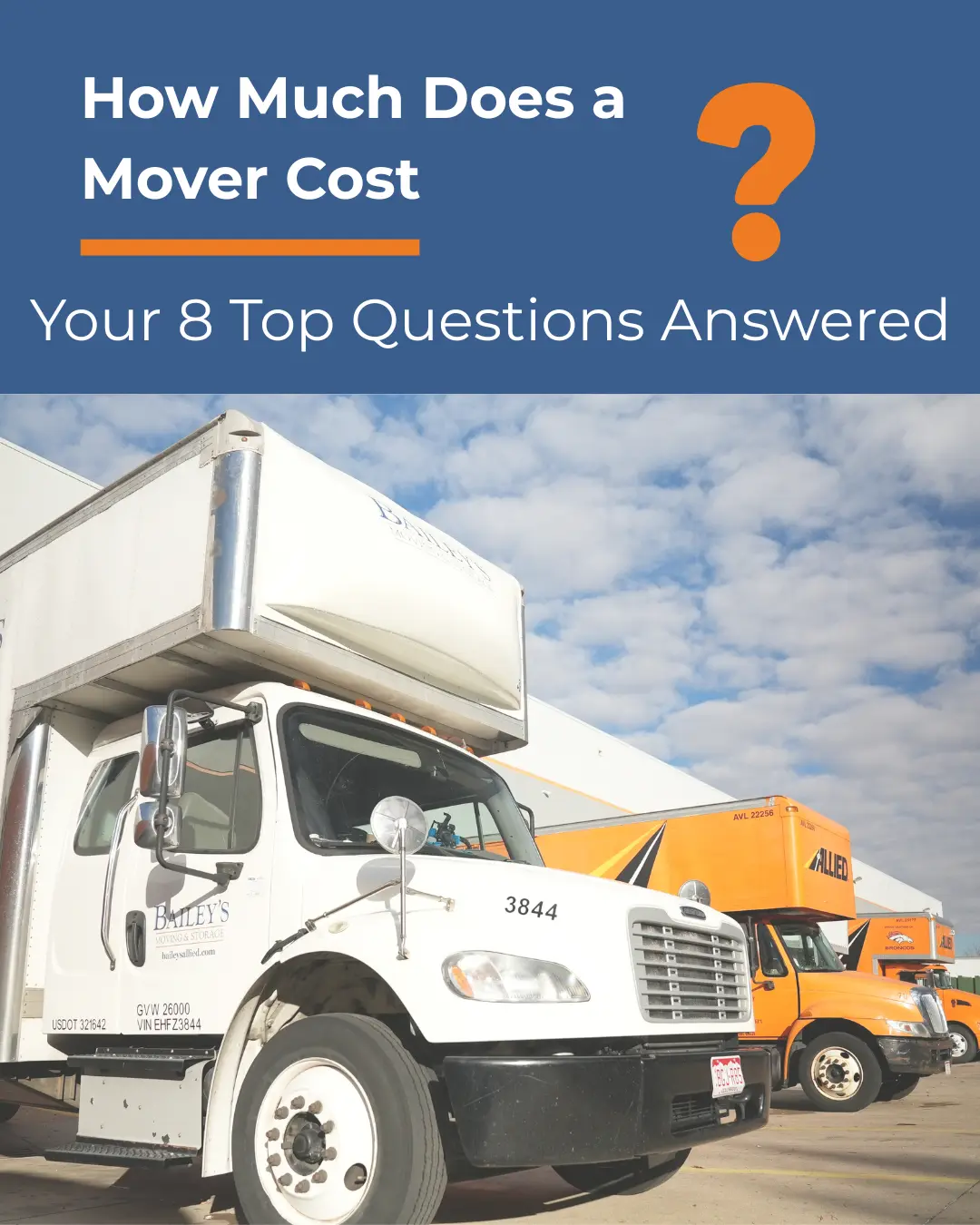
If you’re moving and want professionals to handle the heavy lifting, you probably have questions about pricing, timing, and how your belongings are protected.
We’ve made it simple by answering the eight most common questions our customers ask about moving with Bailey's before booking a move.
1. How Much Does Moving Cost? 3 Most Asked Questions & Comprehensive Answers
Hiring a mover is a big decision based largely on how much it costs. There are things you need to know before trusting a moving company with your belongings.
We break down how your move type affects pricing, why estimates are important, and how to cut costs when hiring a mover to fit a smaller budget.
How Do the 3 Move Types Increase or Decrease My Final Bill?
The distance between where the move starts and ends is a central component of moving cost calculations. Read on for a detailed explanation of each move type.
Local Moves
Local moves are up to 50 miles, and we charge per hour, not by weight. Charges start when the truck and team leave the warehouse and end once they return to the facility – we charge for the whole time they are in service for your move.
Shorter or longer distances and traffic impact driving times and pricing. Your price can be higher or lower depending on what services you need and how extensive the move is. All moves are subject to a minimum amount depending on location.
Intrastate Moves
An intrastate move is over 50 miles and can exceed 300 or 400 but doesn’t cross state lines.
Interstate moves are more complex and charged by weight and by distance. Subject to minimums, how you're charged depends on the amount of stuff, the number of miles, and total shipment weight. Keep in mind that our peak season and any services you add can increase these rates.
Based on our 2025 numbers, here are average costs for a local, intrastate, and interstate move.
- Local: $2,000 and $4,000
- Intrastate: $5,800 and $7,000
- Interstate: $9,000 and $11,000
What is a Moving Estimate & How it Helps Hire the Best Mover for You
We look at the amount of items you’re moving to estimate how long your move will take and provide a written binding or non-binding estimate with your projected price. Estimates are the best way to hire the mover that’s right for you. Get and compare at least three so you can spot red flags and weed out companies that are too high or unrealistically low.
Ideally, an estimator helps you compile an accurate inventory list during an in-person appointment. You can schedule a virtual appointment, but in-person is more accurate.
Don’t get scammed. Read “Avoid a Moving Scam.”
Non-Binding Estimates
With non-binding, we calculate the final charge once we get the actual weight of your shipment. The final price can be higher or lower than the estimate (though all non-binding estimates must be reasonably accurate to your final cost).
Binding Estimates
Alternatively, you can book your move with a binding estimate. Binding estimates base your move costs on the itemized inventory and the scope of services you need. If the inventory list and estimated capacity match what was presumed, you'll know your price before you move.
Binding estimates are unchangeable unless additional items are loaded, or services are added on moving day. Additional expenses require a Change Order to document the extra expense.
Read “What is a Binding Estimate?” for more details.
Are Moving Prices Negotiable & What if the Price is Higher Than My Budget?
Customers sometimes ask if the price is negotiable. That is a fair question. We always give you the best price based on your itemized inventory and the services you need.
The Best Ways to Afford a Mover Even on a Budget
There are ways to reduce the estimate price for a stricter budget, including:
- Move Less: Remove items from your inventory list (donate or sell more stuff before moving day)
- DIY More: Eliminate an extra service (DIY packing)
- Plan Better: Schedule your move during off-peak season or on a weekday with lower rates.
Learn “How to Move Cheaper & Still Get Moving Company Perks.”
Work with your estimator who can help give you the best possible arrangement.
We need to book it with firm move dates before we can issue a binding estimate or promise any rates.
Pricing depends on seasonal and weekly demand. Rates fluctuate more frequently during peak season and on certain days of the week. Ask your estimator about off-peak and lower-rate moving days to cut costs.
Once you're on the books, though, your price is locked in unless you opt to change the scope or inventory.
2. Your Moving Timeline: How Long Will My Move Take?
Understanding how long it takes can be tricky if it’s been a few years or you've never moved before. We always do our best to accomplish your move in as little time as possible.
We include your expected shipment arrival date or delivery spread in your contract. Inclement weather and route delays can affect that timeline.
Every move is unique. The length of the move depends on your situation, but these timeframes apply to most customers:
- Packing (if we're doing it for you): 1-3 days
- Loading: 1-3 days
- Transit: A few days, up to 2 weeks (depending on where you're going)
- Unloading: 1-3 days
Read “The Moving Timeline” for more details.
Longer distances take more time. Most interstate moves require 2-3 weeks from start to finish. Local moves take around 1-3 days in total.
Your estimator understands the unique logistics of your move and will let you know if your timeline changes.
When Will You Load & Deliver My Shipment? Why Don’t I Have a Specific Date?
Loading and Delivery Timelines
We give you a range of days for loading and delivery because demand and crew availability can push your timeline to a day or two later. Date ranges are based on the distance between the old and new place and how much your shipment weighs.
Federal regulations limit a driver’s miles per day. They are required to log their time and mileage electronically, whether they’re driving coast to coast or across state lines. Each truck is packed for efficiency, so they may also need to stop along their route to load and unload additional shipments.
Unexpected factors frequently affect delivery day and unloading times. Your estimator includes details that affect your shipment load date in your written contract. We are as efficient as possible, but delays happen typically for these two reasons.
Inclement Weather & Mechanical Issues Can Affect Your Shipment Delivery
Hurricanes, blizzards, and other weather-related storms can delay delivery times. That’s why we ask that you’re available with a minimum of 2 hours' notice within your date range.
Mechanical failures with the tractor do happen, and the driver will try to coordinate the transfer of your shipment trailer to another tractor as the fastest option to complete your shipment delivery. If a different tractor isn’t available, the driver may delay the shipment while the tractor or truck is repaired.
What Happens if the Weather or Mechanical Issues Delay My Delivery?
Also, note that you may be eligible for a delay claim if the delivery moves outside the delivery date range. Review it with your estimator to make sure you're eligible and understand how it works before you sign the move contract.
Once the drivers are on their way, we rely on them for location and arrival updates. Don’t worry, you’ll be in the know on any changes.
Local, Intrastate, and Interstate Moving Cost Takeaways:
- Local moves cost between $2,000 and $4,000.
- Intrastate moves cost between $5,800 and $7,000.
- Interstate moves cost between $9,000 and $11,000.
3. What Happens if Something Breaks During a Move?
Our seasoned crew and drivers are some of the best in the business. But things can still break. That's why valuation is an important part of your estimate. Think of it as one of the key decisions to make when you book your move.
Technically not insurance; moving companies offer standardized protection over your household goods.
What Are My Options to Protect My Belongings During a Move?
There are three moving coverage options to protect your belongings during a move. You can:
- Add Full Valuation for full (replacement) value protection
- Release the liability of the moving company via waiver for standard or basic $0.60 per pound coverage
- Purchase third-party cargo liability insurance
FYI: Unless you specifically ask for the basic option before moving day, moving companies are required to default to full coverage and include the extra costs.
Even Valuation Has Its Limits
High-value items worth more than $100 per pound of their weight need to be disclosed separately. Add high-value items to a specific inventory list with your estimator to protect them for their total value.
High-value items include:
- Antiques
- Artwork
- Electronics
Who Packs it is Responsible
Valuation only covers damage to items the mover packed. The professionally packed box must be damaged. Otherwise, broken items in an undamaged box aren’t covered. Since the moving company didn't do the packing, they can't be held responsible.
This rule protects movers from people hiding damaged items inside a box and blaming their moving company.
Valuation Takeaways:
- Ask for Release/Basic coverage before moving day to avoid the required Full Valuation coverage.
- You Packed It: The moving company is not responsible.
- We Packed It: We are responsible if the outside of the box is damaged.
- Work with your estimator to cover high-value items and document them on a specific inventory list.
Get all the valuation details in “Why Valuation is the #1 Thing You Should Know Before You Move.”
4. How Does Storage with Bailey's Moving Work & How Much Does It Cost?
We offer storage in Utah and Colorado with over a quarter-million square feet of climate-controlled warehouse storage space. We also work with companies around the nation and the globe to store items for you.
When You Should Use Storage & Options When You Need it
Sometimes your move out and move in dates don’t align. Short-term storage is a good or best option when you have to move out a few days before your new place is available to move in.
You essentially move twice, which is double the work and stress. That’s why short-term storage can help ease both.
Long-term or permanent storage helps those who are relocating for a longer period of time without moving all of their belongings.
Our driver conveniently brings the shipment to our warehouse where we pack it into our vaults. Each vault holds approximately 1500 pounds.
See how storage can complement your move in “Cost of Moving Self-Storage.”
When you’re ready, we can deliver your stuff anywhere in Colorado, Utah, or around the world.
Choose between three storage options:
- Short-term Storage: One or two months
- Long-term Storage (or Permanent Storage): Helpful for customers who need to store for 12 months or longer.
- Storage in Transit: A great option when you must move out but the new place isn’t ready to move in. (Mostly for local moves)
People ask if we can hold items in the truck for a few days. The answer is – no. In most cases, the truck your shipment is on has another move lined up.
How Much Does Storage Cost?
It depends on how much you want to store. Like most moving and storage companies, we calculate the cost per month for every 100 pounds of weight.
There are additional handling charges to pack and remove items. Monthly storage prices range, but an average single-family home might expect to pay between $400-$800 per month to store, plus handling charges, depending on availability.
5. Do I Have to Share a Truck with Other People?
In local moves, your household goods are often the only items in the truck. But, with interstate moves, your shipment will most likely be loaded with other shipments to save you money and our crew time.
Interstate shipments are typically not large enough to warrant a whole truck, so we try to load other shipments going in the same direction, making it economical for everyone.
Can I Load My Vehicle with My Shipment?
Most movers use an auto transport trailer that has a specific tie-down system to accommodate every make, model, and car size. This reduces damage to vehicles during transport to little or none. They are also cheaper.
6.) Are You a Move Broker?
We are not moving brokers. All our crew, trucks, and equipment are owned and operated by us.
Here's how to see the difference:
- Our team and trucks come to load or unload you.
- We operate a fleet of more than 80 vehicles, employees, and drivers.
- Our crew is all trained and seasoned in the art of moving.
What If I'm Working with Bailey's Moving & Storage, but the Truck Has a Different Allied Agent on the Side?
We are an agent of Allied Van Lines, and sometimes crew or trucks that aren't owned by Bailey's Moving help with interstate or international moves.
We have specific partners and trucks that are part of the Allied Van Lines network from another agent to help you move, but we still retain control of the quality.
Allied Van Lines is a family of independent moving companies that work together to move people around the country.
You’ll work with us at the origin or destination, depending on how and where you're moving. Our partnerships with Allied agents across the globe help us move you anywhere across the nation at a reasonable price.
7. Is Your Moving Crew Comprised of Employees or Contractors?
Our moving crew are mostly trained and vetted employees, supported by trained long-term contractors we hire for larger shipments.
Our employees work locally, so they're most engaged in loading or unloading customers in the local area. We hire, train, and help them forge careers in the moving trade.
We are lucky to have a crew of employees who have worked with us for over 20 years, but we still use contractors in specific circumstances.
Read “Why Van Lines Mean Higher Quality” to learn more about van lines, movers, and brokers.
For example: We use packing contractors if needed to stay on schedule when our crew’s availability is tight. Don’t worry though, our contractors and employees meet the same high standards.
We often use our experienced contract drivers to haul your shipment on long-distance moves. These drivers hold specialized positions and are referred to as owner/operators because they operate their own trucks independently.
Nearly every van line works this way to load and unload customers more efficiently. In the end, whether an employee or contractor is performing a service for you, we take significant steps to ensure you get exceptional service.
We have specific partners and trucks that are part of the Allied Van Lines network from another agent to help you move, but we still retain control of the quality.
8. How and When Do I Pay for Services?
Your mover must issue you an honest freight or expense bill. You have a contracted amount, or an accurate estimate with clear explanations of when you will incur additional charges.
You will be expected to pay one of the following once your shipment arrives:
- 100% of the charges on your binding estimate.
- 110% of the charges on your non-binding estimate.
In addition, you're expected to pay for any additional services requested during the move, including:
- Waiting time
- An extra pickup or delivery
- Storage
We pre-authorize a credit card before loading to ensure your card has sufficient funds, but the actual charge happens on or after delivery.
Your mover must add the forms of payment they accept at delivery on the order for service and the bill of lading. Do not assume your mover accepts payment by credit card unless it is clearly indicated.
Bailey's Moving & Storage accepts credit cards and offers financing.
What If I Don't Pay at the Time of Delivery?
Movers have the right to refuse delivery of your shipment if you don’t pay when they deliver the shipment. They typically place it into storage at your expense until the charges are paid.
Regulations say that when your mover arrives at the destination, the mover may collect the payments due before unloading the shipment. They are legally allowed to hold your shipment until you pay the company.
That's why credit cards are the most common payment for moving customers. It allows us to pre-authorize the funds and collect them from your card automatically on or after delivery. You know the amount before we collect it.
Payment Takeaways:
- At the time of delivery, you'll either pay 100% of the charges on your binding estimate or up to 110% of the charges on your non-binding estimate.
- Before your shipment is delivered, you and your mover will discuss the forms of payment they accept.
- Most movers charge via credit card authorization.
Are you planning a move? Try our free online estimator tool or schedule an appointment with one of our estimators.
Have Any Additional Questions? We'd Love to Hear Them!
You can reach us at 888-260-5717 or through our website.


