
On this page
Key takeaways
- The post says rising rent, return-to-office policies, job uncertainty and retiring baby boomers are driving local moves in Colorado, citing sources such as the Bureau of Labor Statistics, the Denver Post and the National Association of Realtors.
- It reports that packing is the most dreaded part of moving and that people underestimate how long it takes and how much heavy lifting is involved, citing Anytime Estimate and Airtasker surveys.
- It describes decision fatigue, anxiety, procrastination, ADHD and relocation depression as factors that can make a move harder, citing sources such as the Cleveland Clinic and Healthline; it is general information, not medical advice.
- For mountain moves, it advises planning for narrow or steep access, shuttling items from the road, protecting surfaces from gravel and dirt, and bringing extra help because of the altitude.
- It compares full-service, hybrid and DIY moves, and says a hybrid move lets you do some tasks yourself while a moving company handles loading, unloading or other heavy work.
Sometimes life tells you it’s time to move! Sometimes rent is too high, you’re going back into the office, or retired life is calling. Moving is torturous for nearly everyone, and today’s housing, economic, and daily-life uncertainties are nudging more people to relocate.
Colorado’s unique housing and rental markets, workforce shifts, and aging populations are prompting local moves across this western state. Bailey’s Moving understands the impact uprooting a person’s life has on their financial and emotional situation. We dug into the data on Colorado’s top moving needs: why people hate moving, what factors make the experience even worse, and what moving methods are less painful for which personality and emotional types.
Life Happens: How Rent, Workforce Trends, and Aging Shape Local Moving in Colorado
Moving is painful enough! Life’s “surprise … you need to move!” moments are catching Colorado residents off guard. Let’s explore how housing, the job market, and the Silver Tsunami are shaping local moves within the Centennial State.
First, a quick overview. These are the key reasons people are moving:
- Buying a house is harder: Colorado is in the top 10 for least affordable housing and tackling an estimated 106,000-unit gap.
- More Colorado residents are renting than in the prior year: Homeownership rates continue to decline, slightly. Nearly 34% of households rent rather than own.
- CO Unemployment: As of August 2025, 4.2% of Coloradans are unemployed.
- Return-to-Office in Colorado: While Boulder, with 28% and Denver with 22% have higher than average work-from-home rates, most Colorado employers are asking employees to work in the office or on a hybrid schedule.
- Aging baby boomers are retiring: Based on generational data, 25% of older baby boomers’ home purchases were senior-related.
- Two Colorado Cities Ranked as Affordable Retirement Options: Fort Collins is ranked 22nd, and Colorado Springs came in 13th as more budget-friendly places to retire.
Renting in Colorado
Colorado's mile-high home prices, mortgage rates, and availability gaps continue to push ownership goals farther out. Renting as an achievable interim goal has prompted over 33% of Coloradans to pack up their belongings and move locally into rentals. Rental choices are increasing, but finding areas with reasonable monthly rent takes some digging. A Redfin article, “11 Most Affordable Places to Live in Colorado in 2025,” highlights Pueblo, Grand Junction, Colorado Springs, and Greeley as more affordable areas to rent.
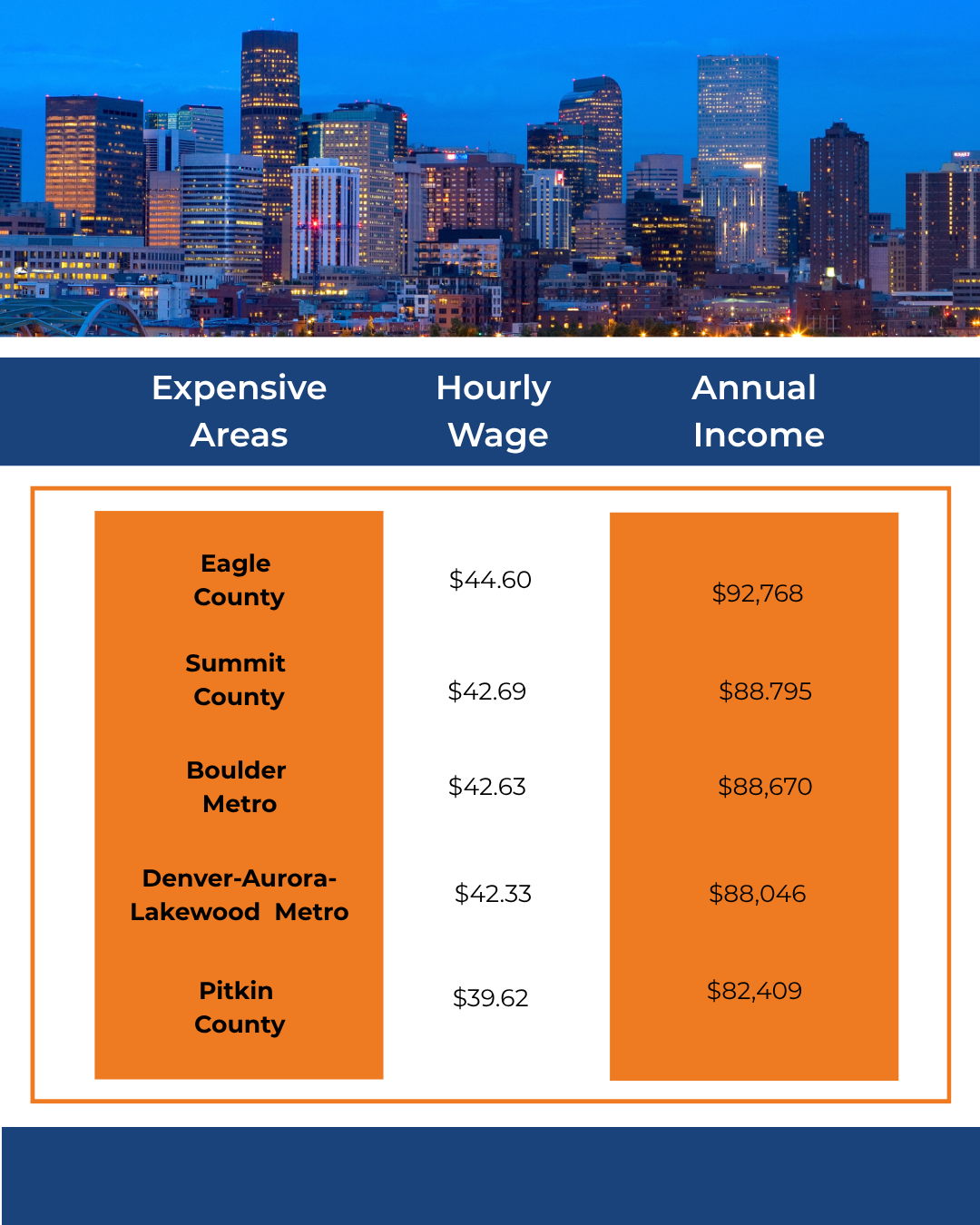
The most expensive areas to rent based on a two-bedroom home average Fair Market Rent (FMR) include Eagle, Summit, and, not surprisingly, Boulder Metro counties. Looking at rent affordability through an hourly wage lens offers more clarity. Would-be renters and current renters considering a move to a more appealing area can compare their rate to the average wage for a better idea of what’s possible. The National Low Income Housing Coalition (NLIHC) provided a 2025 Colorado Housing Profile with housing wages for the most expensive places to rent. The housing wages assume a 40-hour work week and 52 weeks per year.
We Did the Colorado Cost of Living Math So You Don’t Have to
Hourly and annual income in these areas:
As supply, demand, and other factors influence city appeal across Colorado, renters may consider a local move to find lower rent, a closer commute, or buy a house in a more affordable area. An article in Denverite suggested that Colorado Springs and Boulder are possible moving destinations for the 48% of Denver residents searching for other areas.
Condos and townhomes have been good options for homebuyers. Rising Homeowner Association (HOA) fees and insurance pricing have pulled values down by 11%, according to the Colorado Association of Realtors’ “Colorado Housing: A buyer’s market minus the buyers” article.
Workforce and Job Uncertainty Might Be the Catalyst to Your Next Local Move
Layoffs and return-to-office (RTO) initiatives are a common worry across the US and within Colorado communities. The US Bureau of Labor Statistics unemployment report for Colorado indicated a 4.2% rate as of August 2025, which is down from 4.5% in July 2025. Job loss in an increasingly expensive state might prompt relocation within state lines or out of state for better employment and housing opportunities.
Employees who moved farther from work during the pandemic are now either scrambling to accommodate calls to work in the office or waiting for the RTO shoe to drop. If you’re worried about RTO wreaking havoc on your work life, creating a plan can ease stress. Find affordable areas near work in case a local move becomes necessary.
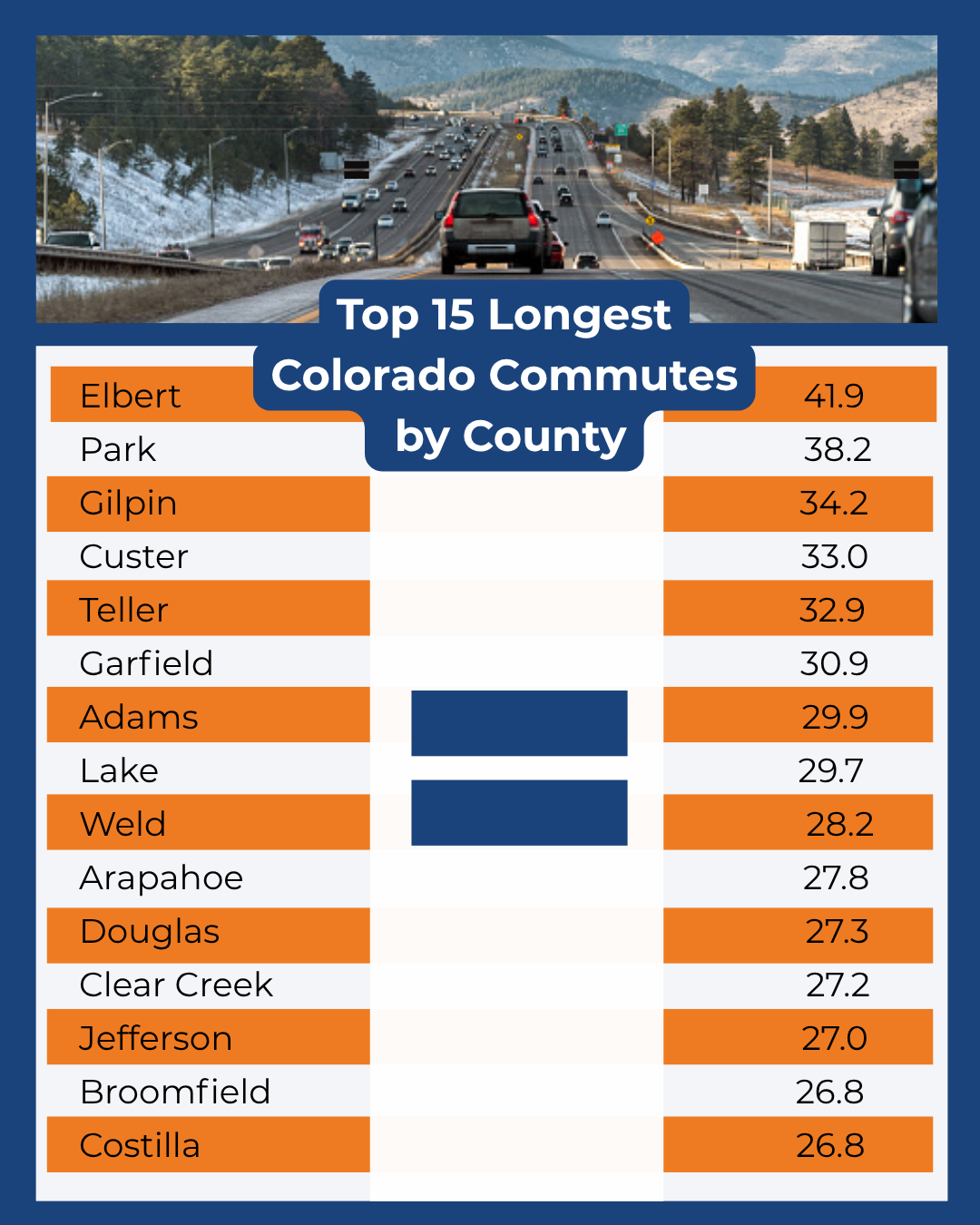
Since RTO looms over some Coloradans' plans and the price of gas is a significant factor in many daily and monthly budgets, we were curious about the longest commutes in Colorado. We found our answer on Overflow Data’s “Which U.S. Counties Have the Longest Commutes?” web page filtered for Colorado. Based on minutes, Elbert, Park, and Gilpin topped the list with 41.9, 38.2, and 34.2, respectively. Here’s the complete list of the top 15 longest Colorado County commutes.
Why the Silver Tsunami is Just a Ripple Now: What Changes Could Mean a Baby Boomer Relocation Wave
There is much ado about the baby boomer population and its potential to reshape things, the housing market and other sectors. The Colorado State Demography’s “2023 Population Summary” shows that over 962,000 homeowners and renters 65 and older live in the Centennial State. This Silver Tsunami was poised to make waves across Colorado cities as aging boomers downsized or moved into senior housing, but most of those plans have changed. Sacrificing their lower mortgage rates and trying to find a comparable home doesn’t make sense.
Colorado’s expensive zip codes and daily-living dilemma are perfect examples to examine the baby boomers’ unique situation. A Home Stratosphere article, “Recent Housing Trends Among Colorado's Baby Boomers,” shows why baby boomers are staying put at least for now. Tight markets, paid-off mortgages, and a bigger home for less money are excellent reasons for aging seniors to age in place in their current residence rather than moving into a smaller home.
Nursing homes aren't the go-to destination they once were. A smaller portion of aging seniors purchased a home to live with multiple family members. In a National Association of Realtors (NAR) article, “2025 Home Buyers and Sellers Generational Trends Report,” home purchase data revealed 15% of younger boomers closed on multi-generational homes, while 25% of older boomers and 27% of the older silent generation purchased senior-related housing.
Don’t Have Retirement Location Envy: Move to an Even Better Area in Colorado
Colorado isn’t on Florida’s level as a retirement destination, but there are some well-kept secrets for an amazing, retired life in the Centennial State. We’re letting you in on the best places for retirees. Here is the top ten based on Breck Life Group’s “Where to Retire in Colorado: 10 Best Colorado Cities to Move to After Retirement.”
It’s not like moving in the 1980s or 1990s; life feels more complex, and our reasons for moving have changed. Affordability and availability are pushing homeownership plans further down the road for some, changing the number of Colorado renters. Baby boomers are reshaping the senior landscape as they retire by aging in place. More people across generations are moving into multi-generational homes or different areas to overcome affordability challenges.
Moving Sucks! How Being Human Affects Your Move Prep and Experience
If people actually enjoyed moving, it wouldn’t top the list of life’s stressors along with job loss, death of a loved one, and divorce. Uprooting your life is hard, even if it’s for something positive like a new home or a great job. Packing, decluttering, and organizing a move can be overwhelming for some and a complete nightmare for others. Uprooting your life is overwhelming. Anxiety, procrastination, ADHD, and juggling a long list of logistics can intensify stress during the moving process.
Anytime Estimate surveyed 1,000 Americans who moved in 2024 and highlighted the results in their article, “2025 Data: 70% of Americans Have Regrets About Moving.” Over 80% of respondents said moving was stressful in general, while around 50% put moving stress over divorce, job loss, and the death of a loved one. That ranking says a lot about the experience.
Planning and juggling the logistical details play a huge role in our aversion to moving. We can and will forget a step or stumble over a decision, task, or timeline during the process. Flawless moving stories are hard to find, but horror stories are everywhere, which is why over 40% of Americans cried during a move in 2024.
You Already Know That Moving Sucks. Here’s What Other People Said About Why
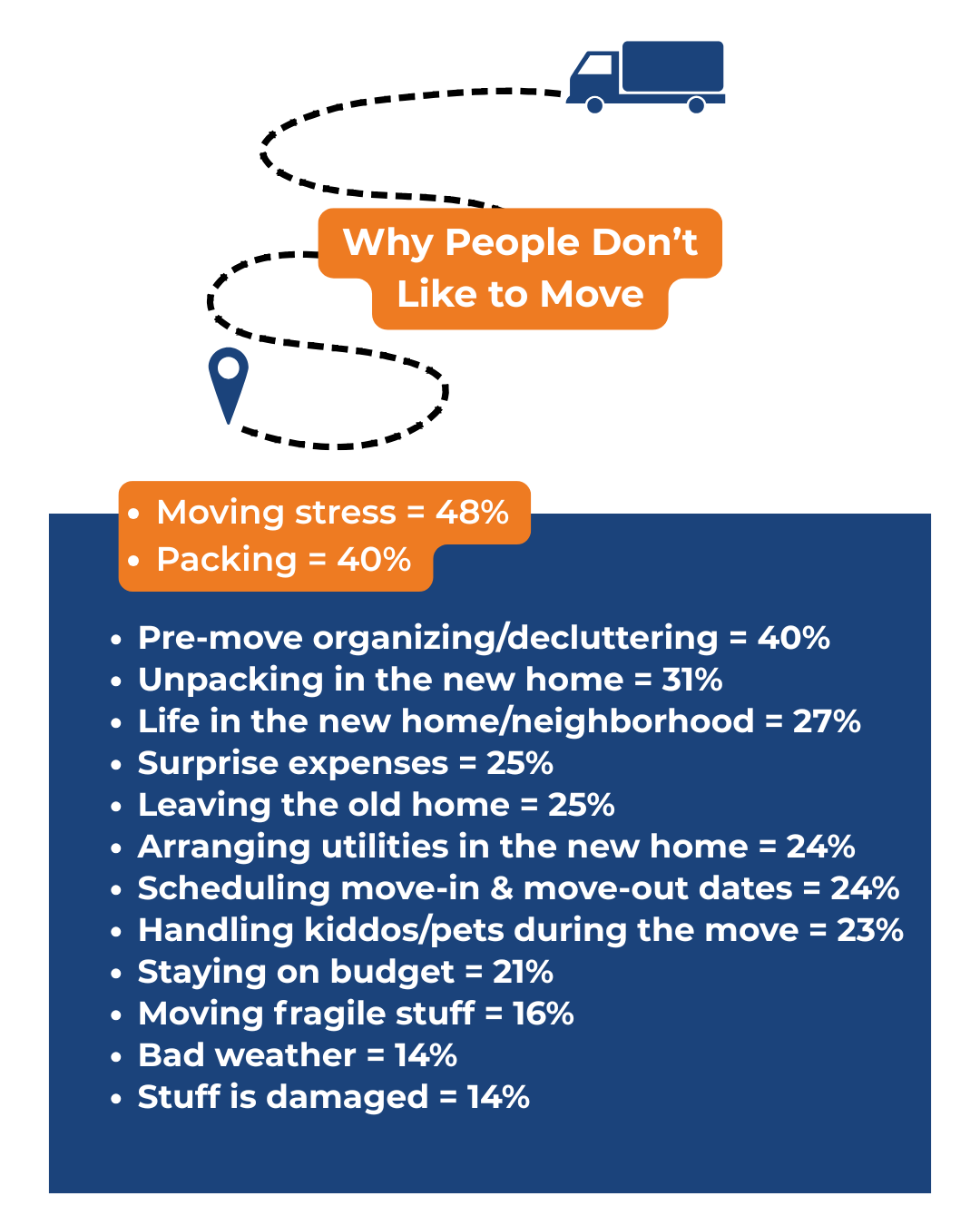
People Agree that Packing is the Worst. Here's Why It's So Stressful
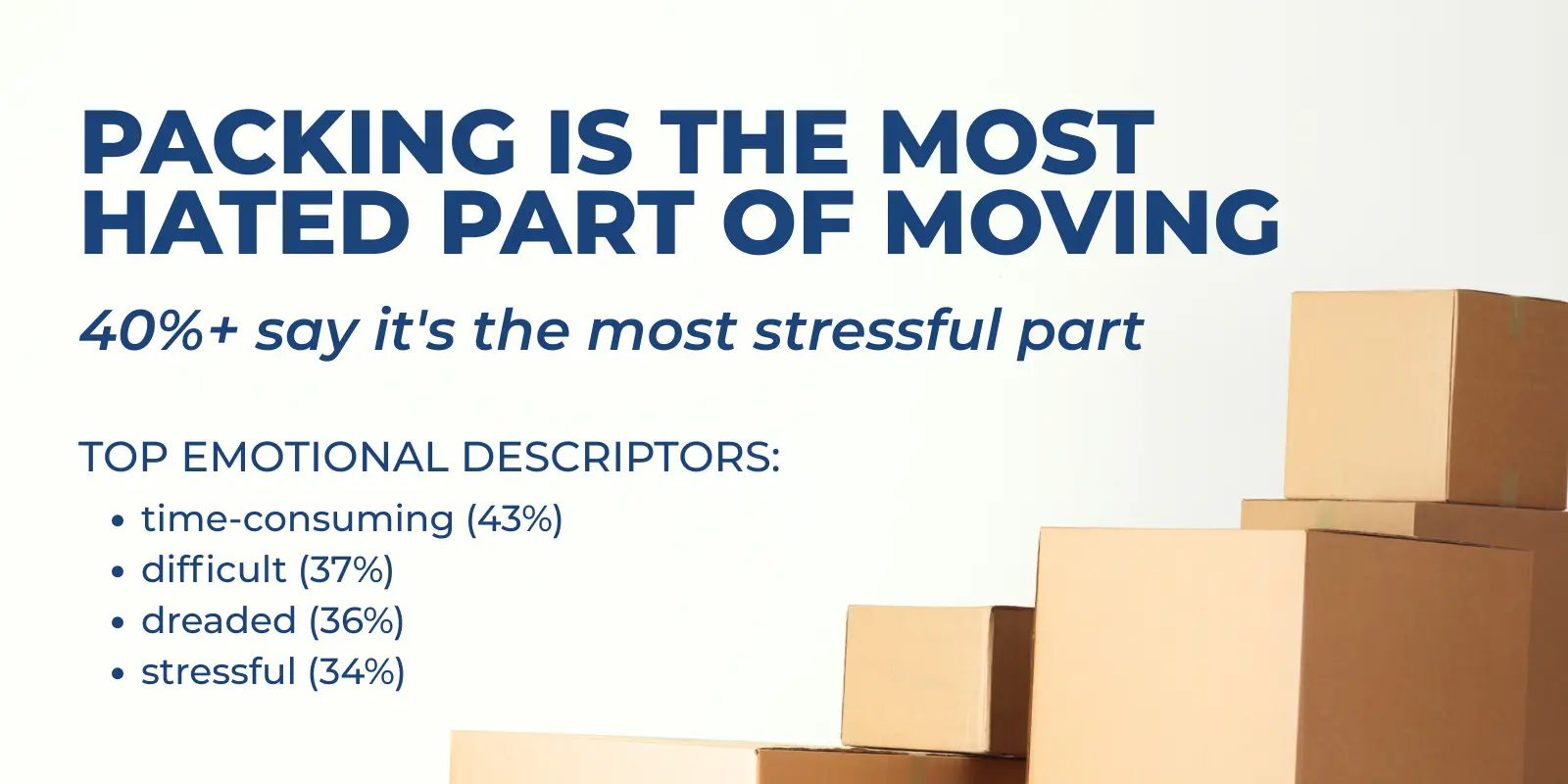
DIY packing or packing-in-place is often the most dreaded part of moving. Almost everyone who has moved at least once likely agrees that packing contributes to its fair share of frustration and stress. Airtasker’s blog, “More than 40% claim packing to be the most stressful part of moving,” called out packing as the most stressful for almost 41% of research respondents. Unpacking wasn’t far behind at nearly 21%.
How do you feel about packing for a move? Anytime Estimate’s “2025 Data: 70% of Americans Have Regrets About Moving“ article covered the most common feelings. Here’s a breakdown with percentages.
Describe packing as you like, but putting your life into boxes is a daunting task. Unless you’re a devout minimalist, chances are you own a lot of stuff. So, you’ll need to estimate how long it will take, the number of boxes and rolls of tape you’ll need, and how much to pack each day. It’s easy to misjudge or underestimate one or a few of the factors involved in packing your things before a move. People accumulate a lot of stuff, whether they’ve lived in their home for one year or ten.
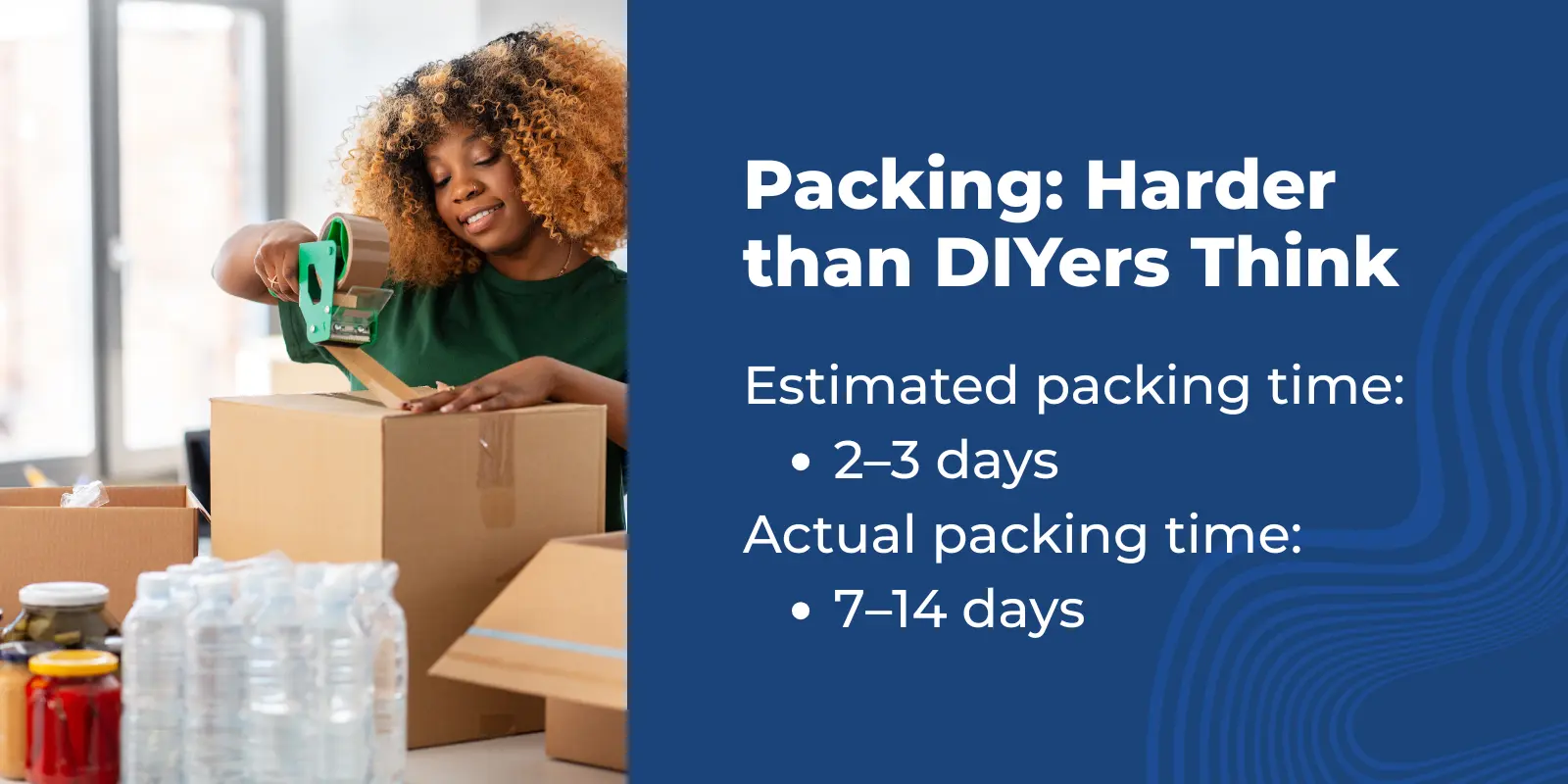
That same Anytime Estimates article compared estimates with reality and, as you can imagine, the two don’t match. Here’s what they found.
Estimates vs. What Really Happened
Packing-in-Place: Life Happens While You’re Trying to Pack
Packing is central to the process across all moving types, from local to international. We call it packing-in-place because you essentially live in the home while putting its contents in boxes. Life doesn’t stop because you’re packing. Most DIY movers have to squeeze filling those boxes into their daily lives. Packing for a move today likely means doing it all by yourself, before or after work hours, on weekends, and while young children are sleeping.
Packing yourself is a knee-jerk reaction and a money-saving choice when you’re moving. But it’s the most dreadful and time-consuming part. It's the go-to task for saving money, but in the long run, hiring a professional can help reduce the level and duration of your stress. Pull off the band-aid, hire a moving company to pack, and reclaim that time for work, time with friends and family, or other moving logistics.
We gathered employment, household, and marital status data for a realistic overview of the most common challenges of packing while life happens. Here’s what we found.
Packing While Working
A Colorado Department of Labor and Employment Press Release, “Colorado Employment Situation – August 2025,” shows 3,136,500 employed individuals in the Centennial State in August. The state has a higher employment ratio for the 16-year-old and older population at 64.6% compared to the national 59.6% in August.
Packing Solo
Packing for a move by yourself requires more focus and time, which many Coloradans lack, particularly those who work or are job hunting. We explored Census Reporter’s household and marital status Colorado data for an overview of potential solo packers. Here’s a breakdown.
- Male/Female Householder: 17%
- Divorced: 21.8%
- Widowed: 6.5%
- Never Married: 67%
For all you DIYers - Hire a moving company to handle the worst parts of moving. It's the best decision you'll make.
Yay for you - if you’re single and have help packing for a move. If you’re packing solo, it can be an overwhelming task. We feel your pain! How much is your sanity worth? Moving is tough enough – take some of the weight off your shoulders. Hire a local moving company just to do the packing and still save money.
Packing While Emotional
Those emotions, mementos, and memories are slowing you down. Our packing crew has identified emotions as one of the top three reasons DIYers take significantly longer to pack than moving companies. Yes, packing yourself often adds more time because your emotions and memories can make you spend hours looking through photo albums, and waste precious minutes figuring out what to pack first, next, and last.
As a Bailey's Moving Sales Team member, Jamie Fair has seen this emotional impact on increased packing times and understands explained the striking contrast.
We can come into a large house and pack it in two days, where a client would be able to pack it in two months, maybe.
The stress from moving doesn’t disappear once the moving truck leaves. Anytime Estimate’s research revealed that packing is the task people dislike the most. It also showed that unpacking weighs in at 56% as a stressful, difficult, and dreaded task in the new place. After a move, it doesn’t typically take Americans as long to unpack, but around 26% take over a month.
How many of us still have unpacked boxes in a basement corner or crawl space? I do. In fact, 25% of Americans are not 100% unpacked.
Avoid Extra Moving Stress – Don’t Miscalculate How Long It Takes & What You Need
No one wants to scan their apartment or house and say, “Yep, this is at least three months' worth of folding, wrapping, and sweating over a million cardboard boxes. Yay!” It’s super easy to misjudge how much stuff you own. Underestimating the labor involved is even easier.
Our tendency to miscalculate the packing leaves us vulnerable to the uneasy realization that we need more time, a bigger truck, or both. We call it "moving dissonance" because many of us believe moving takes less time and effort than it actually does.
The misery of moving spans the world. An article from The Property Daily,”73% of Home Movers Say Poor Planning Wasted Hours – Here's What Went Wrong,” showed that a high percentage of people moving in the UK, 73%, reported wasting hours due to poor planning or logistical issues. The number of trips, number of days, and vehicle size negatively impacted movers the most. Here’s the reality.
- 4-9 lost hours for 40% of movers
- Smaller vehicles meant more trips for 47% of first-time renters
- 31% anticipated 1-2 trips to move everything – surprise, it took more for over 80%
- Only 26% moved everything in 1-2 trips
- Most moves, 83% took over one day
- 29% of moves were up to 2 days
- 23% needed 3-6 days to move
No One Wants to Help You Move: The Stress of Moving Isn’t Just You
Saving money on a local move feels awesome. But how much do you really save? Sometimes, a DIY move can cost more than hiring a moving company. Are backaches and tears really worth saving a few hundred dollars?
Helping someone move is a nice thing to do, but no one really wants to. Carrying boxes up or down steps a hundred times, struggling with heavy furniture while walking backwards, and cleaning the corners of empty rooms is not a fun day, especially when you’re not the one moving to a new house.
Most of us have either helped a friend or family member move or asked them to help. Chances are, they said “yes” but felt “no” inside. Airtasker’s article showed that 55% asked friends and family members to help on moving day, 54% hired professionals, 6% hit up their neighbors, and a surprising 3% asked an ex.
The Anytime Estimates article, "2025 Data: 70% of Americans Have Regrets About Moving," confirms that a significant number of Americans believe that moving companies overcharge, leading almost half to opt for the DIY route, if they can rely on help from friends and family. Most of the people you ask might agree to help, but don’t really want to. Anytime Estimates revealed that 29% of Americans dodged moving help with an excuse.
In the US, just under half, or 46%, were confident in being able to move themselves. And while DIY movers rated their experience with a 6.7 average score out of ten, 35% of them hurt themselves at some point during the process. Over half of Americans typically underestimate the amount of heavy lifting and physical labor involved in a move, which can result in a long and tiring couple of days.
Moving While Emotional Makes Everything Take Longer - Now, Start Packing
Moving to a new city or state is an exciting fresh start, but there’s a catch. You uproot your familiar life and daily routines. The home you’re living in holds good and bad memories, and you have a sense of control over habits and routines. Moving disrupts almost everything as you decide on logistics, pack your possessions into boxes, and prepare to leave your comfort zone behind. Packing and cleaning are physically tiring, while planning and making impactful decisions are mentally exhausting.
These are unavoidable aspects of moving, even local ones. We’ve helped thousands of people with local, intrastate, interstate, and international moves and recognize the emotional toll of uprooting your life. Read on as we shed light on the human side of moving so you can give yourself more time, make decisions earlier, and plan a less stressful move.
Moving Makes You Tired: Beware of These 2 Types of Fatigue – Physical & Decision
You pay attention when your body is tired, but you might ignore when your mind is exhausted. We make our best decisions from a limited amount of cognitive bandwidth or energy. Each decision consumes some of our decision bandwidth as we start our day with plenty of sleep, feel good, and have minimal stress. This energy wears down, impacting the quality, speed, and sense of overwhelm we experience as we continue making decisions throughout the day.
You slow down from a run to a walk, your muscles ache, and your legs shake when your body gets tired. Your mind, or mental muscle, can be exhausted with decision fatigue. When motivation drops, you may procrastinate or avoid tasks, become irritable, snap at people, and make impulsive decisions. According to Dr. MacLean in AMA’s “What Doctors Wish Patients Knew About Decision Fatigue” article, we most often procrastinate, make impulsive decisions, avoid, and become indecisive as the main symptoms.
Psycho Tricks in the article, “The Psychology of Decision Fatigue: Why Choices Exhaust You,” explained it this way -
Making decisions tires our brains.
If we experience decision fatigue in our daily lives, imagine what planning and implementing a local move does to our decision-making capacity. Scientific sources agree that you make over 30,000-ish decisions a day as an average person. One might also agree that life decisions are complex, such as finding an affordable home in Colorado, whether to rent or buy, and staying on budget. Planning and implementing a move, even a small one, two miles away, can intensify decision fatigue.
The list of decisions and things to do before a local move is long:
- Decide how – DIY, moving company, or hybrid
- The materials – moving boxes, tape, bubble wrap, and Sharpies or labels
- What to do with all the stuff – declutter, donations, selling stuff, throwing stuff away
- Scheduling movers and/or trucks
- Moving help – professional movers and/or people willing to help
- All that time – packing each room + working full time/part time, with kiddos, health issues
- Heavy furniture + dismantling beds, etc.
Making Decisions for a Mountain Move - Some of Them Will Surprise You
- Narrow and steep roads and driveways - Where to park the truck(s) and how to move your stuff across longer distances (smaller trucks & trailers to shuttle items from the road to the home)
- Gravel & uneven roads and driveways – What equipment and protective materials to prevent property damage (cardboard walkway covers, blankets, and plastic furniture wrap)
- High altitude & physical fatigue – How many people do I need to help me & what equipment will make the physical labor easier (gloves, dollies, straps, and experience moving bulky items)
Read our blog on tips to know for local moving in CO & UT for more mountain moving help.
Our capacity to choose how, what, where, and why is limited. If decisions on a normal day deplete our minds, then adding a complex move will drain our mental resources even faster. Dr. MacLean discussed decision fatigue in AMA’s article, “What Doctors Wish Patients Knew About Decision Fatigue.” She said,
The phenomenon is cumulative so that as the person makes more decisions, they may feel worse or more drained as the day progresses.
Moving is Hard - Anxiety, Procrastination, & ADHD Aren't Helping: How to Move Better
For many, moving brings excitement and hope; for others, it can surface anxiety, perfectionism, or even decision paralysis. At Bailey’s Moving, we’ve seen both sides of this journey. We believe that acknowledging the human side of moving is the first step to making the process healthier and more empowering.
Moving While Anxious
Anxiety has become a part of life. It’s hard to find someone who hasn’t experienced it at home or at work. People who don’t typically experience anxiety can feel it during a big life change like moving to a new house in an unfamiliar city. This strong emotion is a big part of why people hate to move.
The Anxiety and Depression Association of America names anxiety as the most common disorder. There are over 40 million adults who deal with anxiety. We’re examining moving anxiety because it goes a little deeper, is more persistent, and impacts the moving experience in different ways.
Packing while anxious can lengthen packing times, hinder decision- making, and increase stress. Anxiety symptoms are uncomfortable and contribute to the stress of moving. It can be a bigger issue when that overwhelming sense of dread, feeling extra jumpy, staying up at night imagining worst-case scenarios, and restlessness are beyond the norm.
Procrastination
Like moving, procrastination happens, adding hours, days, or weeks onto your moving timeline. It is hard to find someone who hasn’t watched TV instead of cleaning, started their taxes on Tax Day, or put off a work project. If the data in Solving Procrastination’s article, “Procrastination Statistics: Interesting and Useful Statistics about Procrastination,” is spot on, we tend to put things off an average of 55 out of 365 days. Some people do it more than others. Up to 25% of adults are chronic procrastinators, likely wasting 1-4 hours a day. Procrastination can get messy! Add too many extra hours to your packing, and you'll end up throwing the rest of your stuff into random boxes on moving day.
Let's do some "procrastination math" and add those wasted hours per day to an average local moving schedule:
A 2-bedroom home fills between 60 and 70 boxes. In an 8-hour day, a Bailey's Moving crew member packs 7 boxes an hour, totaling 60 boxes.
So, a professional mover can pack the entire house in one day.
Those wasted hours can mean 10 to 20 hours to pack 60 boxes. If you're a procrastinator who wastes 1-4 hours a day, consider hiring a moving company to handle the packing. Get it done! Avoid weeks of packing and eliminate the nightmare of scrambling to finish on moving day.
Moving With ADHD
According to the National Alliance of Mental Illness, over 4% of adults experience inattention, hyperactivity, and impulsivity of attention deficit hyperactivity disorder (ADHD). Planning a local move, packing, and managing logistical details can be physically and mentally challenging throughout the process. Some ADHD-associated behaviors can negatively impact your moving plan and derail your progress.
How ADHD Can Impact Your Move
Inattention:
- Easily distracted & jump around on tasks = packing & cleaning take way longer
- Bored with tasks = incomplete tasks & missed deadlines
- Hard to focus on tasks = incomplete tasks & missed deadlines
- Don’t pay attention during conversations = missed deadlines & details
- Lack of motivation = procrastination & tasks taking way longer
Hyperactivity:
- Talking too much = wasted time on the phone & missed deadlines
- Playing instead of working = incomplete & not started tasks
Impulsivity:
- Impatient = give up on tasks & take way longer to finish things
How to Bring It Together Through Stress: A Better Way to Move
The emotional toll of moving is real, but it doesn’t have to define your experience. When you have the right plan and the right people, that local move is smoother. Hire a moving company to carry the heavier load (pun intended).
Save yourself time, last-minute problems, and those 10 pm frantic packing nights. The missed deadlines, extra boxes and materials, rental trucks, additional time off from work, stress headaches, and frayed nerves often cost more in the end.
Here are the many ways a moving company saves you time and your sanity:
- One to two packing days – packing done – check
- Tried & true moving plans – no waiting for friends to show up on moving day
- All the details in order – your kitchen stuff comes out of the truck first
- Consider the problems solved – getting that bulky couch down the stairs
You Made a Bold Move: Unpacked & Still Stressed? Moving Regret is a Thing
Your moving experience doesn’t end when the trucks leave. It’s more like the beginning as you unpack the boxes and settle into your new house or apartment. We mentioned unpacking earlier as another dreaded task. Just like packing, this time-consuming task is overwhelming for a large number of people. In Anytime Estimate’s article, “2025 Data: 70% of Americans Have Regrets About Moving,” 31% of Americans despise unpacking for the stress, difficulty, dread, and having to find a place for everything.
Unpacking is the immediate focus after a move for obvious reasons. Don't forget to also focus on adjusting to a new house, neighborhood, and routines. It can be confusing when you make it through the move but don't feel as happy as you expected. It’s more common than you think, and there is a name for it. We’re talking about what happens beyond the move when stress and unhappiness seem to linger, such as moving regret and relocation depression.
Want more advice? Read our “How to Unpack After Moving” article for packing and unpacking tips.
Uprooting your life and relocating is a major change that a lot of people will second-guess at some point in the process. That same Anytime Estimate article shed light on this common feeling that 70% of Americans have experienced during their move. Let’s break it down. Do any of these regrets sound familiar?
- Didn’t consider the long-term impacts of moving: 34%
- Doubts that moving is the best decision: 33%
- Miss the old home: 18%
- The process wasn’t worth it (too much hassle): 18%
- Unexpected expenses over budget: 14%
Traumatic might be a better description, but it has a happy ending for the majority of people who move. In the end, over 80% of Americans are happy after their move despite moments of regret.
For some people, their post-move transition leads to a certain type of depression. Relocation depression is more common than you think, so we’re examining what it is, why it happens, and what movers can do to alleviate its impact.
What is Relocation Depression? Can Moving Really Make You Depressed?
We call it a “comfort zone” for a reason. Change is hard! Even small changes can disrupt our daily lives, whether it’s a new work process or bringing a puppy home. To accommodate change, we must gain new knowledge, learn a different way of doing things, and incorporate something unfamiliar to us.
If adjusting to a small change is tough, the enormity of relocating to a new house, neighborhood, and city can feel impossible. Whether you thrive or struggle after a move hinges on how well you adjust to the new location and establish routines. Sometimes this drastic change triggers relocation depression, an adjustment-related impact on your mental health.
Adjustment Disorders:
Healthline explained relocation depression in the article, “What is Relocation Depression and How to Cope?” Technically, it’s considered an adjustment disorder, but people experiencing relocation depression feel sad and, well, depressed. While it’s not a formally recognized diagnosis, it is very real for millions of people.
Change triggers stress-related relocation depression. Given the tremendous amount of pressure and stress during a move, it’s understandable that people often feel sad, uninspired, exhausted, sleepless, and unable to concentrate afterward.
If you moved recently and are experiencing relocation depression, there is reassuring news. The Cleveland Clinic described this emotional reaction to stress in its Overview as short-term and lasting around six months.
Is it relocation depression? Here are common symptoms:
Do you feel:
- Sad & “low”?
- Worried & anxious?
- Unable to sleep?
- Unable to concentrate?
- Angry?
- Trapped with no good options?
- Alone & isolated?
Moving sucks before, during, and after the planning, logistics, and physical part of changing your life. The implications echo beyond your change of address. Ask yourself what’s really going on if you’re anxious and sleepless, ignoring those unpacked boxes three months after the moving trucks have left.
Leaving behind familiar places, friends, and daily routines is hard. It’s important to recognize that these feelings are a natural response to the changes that come with starting fresh in a new city or house. Remember,
It’s okay to take time to adapt, and reaching out for support will make the transition smoother.
The Ultimate Goal is Moving with the Least Disruption to Your Life
Moving sucks because it upends your life. So, try for the least amount of disruption.
Bigger homes, longer distances, and larger amounts of stuff can drag a move out longer for weeks or months. Bigger moves are more disruptive, making even a local move more difficult. Time, energy, and stress add up, making you miserable.
How to Move Better: Have a Plan That Fits Life Values & Moving Goals
The cost of moving isn’t just the check or credit card transaction amount. It’s time away from work, lost sleep, stress-filled days, hours juggling phone calls, and scheduling different services. We try to avoid weeks and months of packing and hours or days of physical labor loading and unloading the truck. Replacing lost or broken furniture defeats the purpose of moving it to the new home.
We value:
- Comfortable routines
- Predictability
- Controlling what we can
- Time
- Our stuff
- Whatever gives us peace of mind
Moving Goals:
- Packing doesn’t take forever
- We don’t have to lift and carry heavy stuff – even once
- Loading & unloading the truck(s) doesn’t take forever
- We can find and unpack the essentials right after the truck leaves
- Our life isn’t in shambles the entire time
- We don’t have to pack until midnight – even once
- Nothing gets lost or broken
- Our back doesn’t go out – even once
- No sore muscles or bruises
- We snap our fingers, and we’re done (not happening)
Regardless of size, you must pause life and set your move in motion. Moving your life from one place to another has steps.
Your Life on Pause – Getting to Moving Day
Choose how to relocate from where you are now to the new place
- DIY or hire a moving company?
- What is your timeline?
- What is your budget?
- How much stuff – truck size & how many?
Your Life in Boxes – Getting Ready for Moving Day
- Get boxes, tape, markers, or labels for all your stuff
- What to pack now & later
- Pack all your stuff in boxes by moving day
Surviving Moving Day – Moving Your Life from Point A to Point B
- Load furniture and boxes into a big enough truck
- Have the right equipment to move – dollies, plastic wrapping, blankets
- Unload everything into the new home
- All your stuff is in one piece
Taking Life Off Pause – Adjusting After Moving Day
- Unpack everything and resume your life
Some DIYers move themselves, and it’s not a complete disaster. Most often, though, the packing marathons, forgotten details, damaged items, and underestimated expenses add up. If you’re among the majority, though, you’re overspending, scrambling to solve unexpected problems, still packing at 1 am on moving day, and potentially loading the truck alone because those friends didn’t show up.
Even a local move demands precise logistical planning for a smooth process. The best moving method comes down to three things:
- Do you have enough time and mental capacity?
- How much is the cost to replace lost or damaged belongings?
- Are all the logistical details in the plan?
There are situations where hiring a moving company isn’t a question. Take it from someone who found out at the closing table that DIY wasn’t enough to move out of the house in time for the new owners to move in. Renting your old house at $250 a day because you need more time to move out is expensive. Try hoisting a ginormous couch over a second-floor apartment balcony because there’s no way it fits through the doorway by yourself. (True story)
Situations When Hiring a Moving Company Isn’t a Question
- You are selling a house & have a hard move-out date
- You are moving for a job & have a start date
- It’s a bigger move that will take more than one day
- You’re moving a lot of irreplaceable valuables and need insurance
- You don’t have a lot of free help
- Moving furniture items would be dangerous
Procrastinators, those with ADHD, and anyone with an anxiety disorder should weigh the emotional and lost time costs over the money saved with a DIY move. If relocation depression is a stress-related adjustment disorder, will reducing stress overall, from planning and packing to unpacking, help decrease your chance of experiencing it?
Moving Method Options
Moving methods aren’t all-or-nothing options. You can hire a moving company to save you time, effort, and unnecessary stress throughout the entire process, during the packing, or just the furniture moving phase. Let’s explore the options to see if there is one you haven’t considered that will reduce emotional and physical stress.
Who Chooses Full-Service Moving—and When It’s Worth It
Full-service moving is for people who value their time, sanity, and peace of mind as much as their budget. It’s the option for families and professionals who would rather focus on life’s big moments than on packing boxes, renting trucks, and worrying about what could go wrong on moving day.
With a full-service move, your moving company handles the details from start to finish: planning, packing, loading, transportation, delivery, and unpacking in your new home. You still stay in control of the big decisions—just without the stress, physical strain, or endless to-do list.
Yes, budget matters. But sometimes when you weigh the cost against the time you’d spend coordinating helpers, buying supplies, fixing last-minute surprises, and recovering from exhaustion, full-service often becomes the smarter, more predictable investment.
A Quick Word About Moving Companies vs. Brokers
Moving brokers and moving companies may sound similar, but they’re not the same.
- Moving companies like Bailey’s Moving & Storage directly employ or directly manage the teams who handle your move. They coordinate every detail, keep you informed, and take responsibility for service quality from beginning to end.
- Moving brokers act as middlemen. They book your move and then subcontract it to another company—often one you’ve never spoken with. That can create gaps in communication, trust, and accountability. You’ll typically find them as websites that advertise as moving companies, but they don’t actually have any trucks or warehouses.
Think of it this way: a moving company is your guide through the process; a broker is a go-between. Both can arrange similar services, but only a direct moving company can truly guarantee who will show up at your door.
If you’d like to dig deeper into the differences, we’ve linked to a full "9 Important Questions to Ask Before Hiring a Moving Company."
The Hybrid Move: When You Want Help—But Still Want to Save
If a full-service move isn’t in your budget, the hybrid move is a smart middle ground choice. This approach lets you decide exactly how much help you want from professionals while keeping control of your costs.
In a hybrid move, you handle some parts yourself, like packing or maybe even driving a rental truck, while your moving company takes care of the heavy, time-consuming work. It’s the perfect “best of both worlds” solution for people who want to protect their back, their time, and their budget.
Here are a few common ways people hire moving companies for partial help:
- Load your packed boxes and furniture onto the rental truck.
- Unload everything at your new home.
- Pack and label your items if you need extra hands before move day.
- Disassemble and reassemble furniture safely.
Letting professionals handle the physically demanding parts can dramatically reduce stress and injury risk while still saving money compared to a full-service move.
Why So Many Americans Choose a Hybrid Move
If you choose this route, you won’t be alone. According to data from Anytime Estimate, about 79% of people who hire professionals go the hybrid route, getting help with part of the move instead of every step.
Here’s what movers typically choose help with:
- 33% hire help for loading the truck.
- 21% want driving and transportation support.
- 14% opt for full-service packing and unpacking.
- 12% need help disassembling and reassembling furniture.
Finding Your Right Balance
Before deciding how much to take on yourself, take an honest look at your time, energy, and emotional bandwidth. Moving is consistently ranked among life’s most stressful events, and doing too much yourself can amplify that strain.
Hiring professionals to take on a little more might cost more upfront, but for many people, it quickly pays off in reduced anxiety, fewer unexpected setbacks, and peace of mind knowing it’s done right.
Conclusion
Every move has its own challenges, complexities, and decisions. Stress is a common part of the moving journey, as most people who have moved before can attest. Life doesn’t stop while you’re moving, placing work, family, and other daily-life obstacles in your path as you plan and implement a move.
Personality and cognitive characteristics can slow you down, distract you, and impact your moving method, plan, and progress.
Change is the common thread through every move, impacting the experience before, during, and after. Whether you’re moving down the street or out of state, packing your life into boxes and moving means a new home and neighborhood, different routes to the store and work, and a sense of unfamiliarity that changes your daily routines.
Consider the value of your time, sanity, and prized possessions. The cost is worth it and can save money in the long run, depending on time constraints, deadlines, health issues, and complexities that DIY can’t overcome. Hiring a moving company to help and guide your journey can make your move a little or a lot less sucky.
Frequently Asked Questions
Why are more Coloradans moving locally in 2025?
The post points to rising housing and rental costs, return-to-office policies, job uncertainty and retirement decisions. It cites BLS, NLIHC, NAR and other sources.
What parts of moving do people find most stressful?
The post says packing tops the list, followed by logistics, scheduling and unpacking, citing Anytime Estimate and Airtasker surveys. It also describes decision fatigue as a factor.
When should I hire professionals instead of moving myself?
The post lists situations such as a hard move-out date, a bigger move that takes more than a day, irreplaceable valuables, limited free help and dangerous furniture. Ask a moving company what it covers before you decide.
What is a hybrid move and who is it for?
A hybrid move combines DIY and professional help, such as packing yourself while a moving company loads, unloads or moves heavy items. The post cites Anytime Estimate data on how often people choose it.
How can I reduce decision fatigue during a move?
The post says to decide how you will move early, break the plan into steps, schedule packing blocks and delegate tasks.
Any special planning tips for Colorado mountain moves?
Plan for narrow or steep access, shuttle items if the truck cannot get close, protect surfaces on gravel and dirt, and bring extra help because of the altitude.
Ready to find out what your move should cost? Get Pricing or call 888-260-5717.


