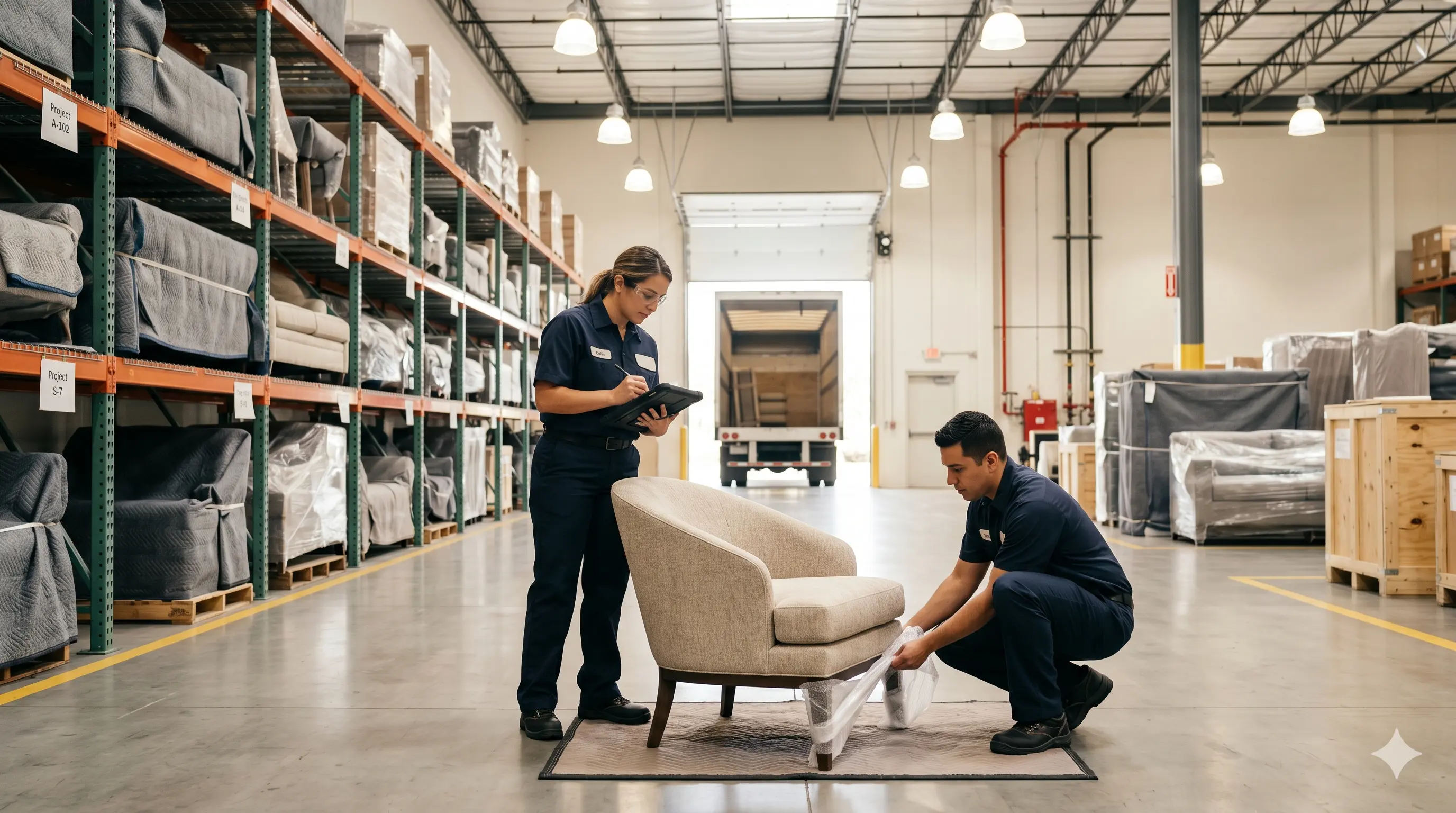
Most designers have a receiving horror story. Furniture shows up at a job site with no inspection record. A $6,000 custom sofa arrives with a cracked frame — and the claim window closed two weeks ago because nobody documented it at intake. A phased hotel install falls apart because the warehouse released everything at once instead of floor by floor.
The FF&E warehousing and delivery partner you choose determines whether your project stays on schedule or spirals into damage claims, missed install windows, and late-night calls to your client. This article breaks down exactly what to evaluate — from receiving workflows to insurance coverage to staged delivery capability — so you can make that choice with confidence.
Bailey’s Workplace handles FF&E logistics for designers and commercial projects across Colorado and Utah — with over 200 active projects running through our Salt Lake distribution warehouse alone at any given time, and well over 1,000 commercial and FF&E projects completed in the last three years across all branches. What follows is what we’ve learned about what separates a real FF&E partner from a company that just happens to have warehouse space.
1. Why the FF&E Supply Chain Demands a Specialized Partner
Before we get into evaluation criteria, it helps to understand why generic warehousing falls short for FF&E work.
A typical furniture item passes through six to eight distinct handlers between the manufacturer and your job site — factory, freight carrier, port, domestic carrier, receiving dock, warehouse floor, delivery truck, installation crew. Each handoff is a damage and documentation risk.
Source: Cahoot
That gap isn’t abstract. On a 20-room boutique hotel project specifying custom seating at $4,000 to $8,000 per piece, a 15% damage rate means you’re statistically guaranteed to deal with multiple damaged items per project. The cost of remediation — filing claims, sourcing replacements, managing your client through a delayed installation — easily exceeds whatever you saved by going with a cheaper logistics provider.
The average project runs 37% longer than originally planned (Buildern). Procurement and logistics failures account for 40 to 50% of those delays (BidBild / Dodge Research). When your FF&E arrives on time but the site isn’t ready — or the site is ready but your FF&E is stuck in a warehouse with no phased release plan — that’s a logistics coordination failure, not a design failure.
2026 supply chain reality: Tariffs on imported furniture, expanded lead times on custom items (12 to 26 weeks depending on origin), and a 15–20% cost increase in white glove delivery labor have pushed the industry away from Just-in-Time delivery toward a Just-in-Case approach. That means more inventory sitting in warehouses for longer periods, waiting for construction schedules to align.
Source: DIG Interior Design
“The storage cycle is a lot shorter now than it was during COVID. Back then, designers couldn’t get stuff here, so they’d order as soon as possible and we’d store it until the project was ready. Now it’s more of a cross-dock — maybe a couple months of storage is all that’s needed since they can time the supply chain a lot better.”
— Lincoln Kelley, Commercial Relocation Consultant, Bailey’s Workplace
The exception: custom pieces, artwork, and auction items, which still sit for extended periods while the rest of the project catches up. The warehouse’s role hasn’t shrunk — it’s shifted from long-term holding to precision staging.
2. How to Evaluate an FF&E Warehousing and Delivery Partner
This is the core of what you need to know. When you’re vetting a potential FF&E logistics partner, here are the capabilities that actually matter — and the questions that separate specialists from generalists.
Step 1: Receiving and Inspection
This is where most project problems either get caught or get buried.
A specialized FF&E warehouse receives freight on your behalf, inspects every item against the purchase order, photographs its condition, and notifies you the same day — with images. That condition report is the single most valuable deliverable a receiving warehouse provides, because it creates a time-stamped record that separates freight damage (the carrier’s liability) from warehouse damage (the warehouse’s liability).
Know your claim windows. Standard LTL carrier liability caps range from $0.10 to $2.00 per pound (BHX Logistics). A $8,000 custom dining table weighing 200 pounds gets you $40 to $400 in compensation under default terms. Visible damage must be noted on the bill of lading at delivery. Hidden damage claims typically require filing within 48 hours to 15 days.
Questions to ask:
- Walk me through your receiving process step by step.
- Do you photograph every item at intake, or only when damage is visible?
- How quickly do you notify the designer after receiving a shipment?
- Can I see an example condition report from a recent project?
“Light fixtures are probably the biggest problem child out there. We don’t typically open and inspect light fixtures for numerous reasons, but they’re the most fragile pieces and they end up getting the most damage. After that, mirrors and artwork — they’re often not packaged well, and by the time they’ve been through a couple of LTL distribution centers, if they’re not protected, you’re going to see damage.”
— Lincoln Kelley
Bailey’s has addressed the upstream side of this problem by updating its warehouse management software to give designers access at the start of a project. As items are ordered, the designer uploads them into the inventory system so that when freight arrives, Bailey’s team scans and receives against a known list.
Pro tip: “Without that process, stuff just shows up as a brown box — there’s a chair in it, but we have no idea who it’s for or what project it belongs to. Having that system at the very beginning allows us to receive items and connect them to the right project immediately.” — Lincoln Kelley
Step 2: Inventory Visibility and Tracking
You need to know what’s in the warehouse, what condition it’s in, and where it stands in the project sequence — without making a phone call.
The reality in much of the industry is still spreadsheets and email. Receiving notifications arrive via email, get manually reconciled, and live in formats that aren’t accessible to clients in real time.
That budget overrun traces directly to missed damage, duplicate orders, and coordination failures that better visibility would have prevented. The minimum standard you should expect: item-level tracking, status updates at each stage (received, inspected, staged, delivered), and condition photography accessible through an online portal — not buried in an email thread from three weeks ago.
Questions to ask:
- Do you provide online inventory access, or do I need to call for updates?
- Is tracking at the item level or the shipment level?
- Can I see condition photos through the portal, or only on request?
Step 3: Staged and Phased Delivery
Can they release inventory in phases tied to your project schedule — not just “everything at once”?
This is the capability that separates a warehouse from a logistics partner. On a multi-phase buildout, a model home rotation, or a hospitality project, you need items delivered by floor, by wing, by room type, or by phase — sequenced to match the general contractor’s readiness schedule.
Source: Armstrong
The right partner catalogs every item by project, floor, and room number, sequences warehouse releases against GC readiness notifications, and participates in pre-installation coordination — not just waiting for “deliver these items” instructions.
Questions to ask:
- How do you organize warehouse inventory — by project, by room, or by item type?
- What’s your process for sequencing a phased delivery on a multi-floor project?
- Do you coordinate directly with the GC or project manager on delivery timing?
Step 4: White Glove Handling and Final-Mile Delivery
Here’s the problem with “white glove”: there is no single industry-standard definition (Ryder). The term is used broadly and means different things to different providers. Some mean “we’ll carry it inside.” Others mean room-specific placement, unboxing, assembly, debris removal, and final inspection before the crew leaves.
In the FF&E context, white glove should include all of the above — plus coordination with the installation schedule, protection of finished surfaces during delivery, and crew familiarity with the types of items being handled (custom millwork and a $12,000 upholstered headboard require different handling than office systems furniture).
Get it in writing. The most important thing you can do: get the scope of “white glove” in writing before you sign anything. This definitional ambiguity is one of the most consistent sources of designer-provider disputes.
Questions to ask:
- What specifically does your white glove service include?
- Do your crews handle assembly and placement per floor plan, or just delivery to the room?
- Do you remove all packaging materials and debris?
- Are your delivery crews the same people who handle the installation, or do you subcontract last mile?
Step 5: Insurance and Liability Coverage
This is the evaluation area most designers skip — and the one that costs the most when something goes wrong.
There are three tiers of coverage you need to understand:
| Coverage Type | What It Covers | Typical Limit | Designer Impact |
|---|---|---|---|
| Released Value | Default LTL freight coverage | $0.60/lb | A 40-lb custom chair worth $5,000 gets you $24. Functionally no coverage. |
| Warehouse Legal Liability (WLL) | Pays only when the warehouse was negligent | $0.50/lb (IWLA default) | Weather event, power outage, or “not our fault”? WLL doesn’t pay. Per-occurrence cap is a blank field you must negotiate. Symbia |
| Bailee’s Customer Coverage | Pays regardless of fault (“bailee” = any party holding someone else’s property) | $5,000+/item at top providers | Protects the designer and the client. This is the standard you should require. |
The best providers in the market offer per-item coverage of $5,000 or more and will name your firm as an additional insured on their policy. If your warehouse partner can’t articulate their coverage structure clearly — or defaults to per-pound liability — that’s a red flag.
Questions to ask:
- Do you carry bailee’s coverage, or only WLL?
- What is your per-occurrence liability cap?
- What is your per-item coverage limit?
- What are your claim filing windows?
- Can you provide a Certificate of Insurance naming my firm as additional insured?
Step 6: When to Engage Your Warehouse Partner
This is the single most common timing mistake we see: designers engage a warehouse after purchase orders are already placed — sometimes only days before shipments start arriving.
That’s too late. Your warehouse address needs to appear on every purchase order. Trade-only vendors — the majority of the high-quality commercial furniture market — will not ship to a self-storage unit or a residential address (Business of Home). Your access to the trade market is functionally dependent on having a relationship with a recognized commercial receiver.
The right time to engage is during the specification phase — before procurement begins. That gives your logistics partner time to set up receiving protocols, establish damage documentation procedures, and coordinate with your project timeline. The warehouse should be part of your project planning, not a scramble when the first shipment notification lands in your inbox.
“We have to go out to different companies and round up all their product. You lose traceability throughout the scramble. You lose accountability on where the damage was caused, whose insurance is going to cover it — if any is going to cover it. In the last stages of an install, it’s really just a scramble trying to get everything to the site without damages or losing anything.”
— Lincoln Kelley, on what happens when designers switch providers mid-project
The contrast with early engagement is stark. On hotel and restaurant projects, getting involved before ordering means Bailey’s can coordinate with vendors on room-level labeling.
“The earlier we can get involved with the vendor, the better the labeling is — we can deliver a whole floor, rooms 1 to 10, instead of bringing stuff up that goes to three different floors. A lot of hotels will actually do model rooms before the big install, so we know the furniture matches up with light plugs, curves, cutouts. We make sure it all lines up first, then make adjustments when the big install comes.” — Lincoln Kelley
Step 7: Flexibility for Project-Based Timelines
Construction delays happen. Design revisions happen. Client decisions take longer than planned. Your warehouse partner needs to understand that FF&E timelines shift — and their pricing and terms should reflect that reality.
Ask about what happens when a project extends by 30, 60, or 90 days. Are there punitive overage charges, or does the provider work with you on adjusted timelines? A partner built for project-based work expects this. A warehouse built for commodity storage does not.
Questions to ask:
- What happens to my storage rates if the project timeline extends by 60 days?
- Is there a minimum storage commitment, or is it month-to-month?
- Do you have experience holding inventory for projects with uncertain construction schedules?
“We had to glue on the marble tops to the dressers. Some of the electricians decided it would be a good idea to stand on the marble tops — the glue hadn’t cured yet, so it shifted them. Installing FF&E while trades are still finishing up makes for an absolute chaotic disaster. You’re sharing elevators, it extends hours, storage costs go up — cost increases exponentially.”
— Lincoln Kelley
His advice is blunt: “It’s much better just to pay for an extra month of storage instead of trying to squeeze it in and running into bigger problems.” For larger projects bid through RFPs, Bailey’s typically builds a buffer into pricing to absorb schedule shifts. “Sometimes that buffer covers it, other times there’s a change order involved,” Kelley says. “But we try to have something built in to avoid any of that.”
3. What Colorado Designers Should Know About Local FF&E Warehousing
Colorado’s commercial interior market is one of the most active in the Mountain West.
Source: Beacon Real Estate
Colorado employs nearly twice the national density of interior designers relative to its workforce, with a location quotient of 1.96 (BLS OES 2023). The Denver-Aurora-Lakewood MSA alone accounts for 1,660 designers at an even higher concentration. The Front Range commercial design community is estimated at 840 to 1,100 commercially focused firms — from major national practices like Gensler and Perkins & Will to a dense ecosystem of boutique commercial studios.
For FF&E logistics, proximity matters. A local warehouse means faster delivery, easier site visits to check inventory, and crews who know the buildings, the loading docks, and the freight elevator schedules. Colorado Springs — which saw a 31% surge in commercial building permits in 2025 (KOAA / Pikes Peak Regional Building) — is increasingly underserved by Denver-centric logistics providers, creating a gap for designers working on projects along the southern Front Range.
Bailey’s Workplace operates across Colorado with locations in Denver, Colorado Springs, and Grand Junction — giving designers along the Front Range and Western Slope direct access to warehouse infrastructure and local crews without relying on a single Denver-centric facility.
4. What Utah Designers Should Know About FF&E Warehousing Along the Wasatch Front
Sources: IBISWorld, Building Salt Lake
But the real story for FF&E logistics in Utah is hospitality — specifically, the extraordinary concentration of luxury resort development in the Park City and Deer Valley corridor.
Deer Valley East Village: $5 Billion in Development
The first major new public alpine ski resort developed in North America in over 40 years. 2,300+ acres of new terrain. 10 new chairlifts since December 2024. Utah Business
| Property | Rooms | Residences | Status |
|---|---|---|---|
| Grand Hyatt Deer Valley | 387 | 55 | Opened late 2024 |
| Waldorf Astoria Deer Valley | 132 | 105 | Construction commenced May 2025; opening projected 2028 |
| Four Seasons Deer Valley East Village | 134 | 123 | Projected 2028 |
| Canopy by Hilton Deer Valley | — | — | Expected 2026 |
Source: Hilton
The Waldorf Astoria alone, with 132 rooms and 105 residences at ultra-luxury specifications, likely carries an FF&E procurement value exceeding $10 million for guestrooms alone.
These mountain resort projects carry unique logistics challenges that most providers aren’t equipped for: crane and lift operations for mountainside delivery, narrow access roads, altitude and weather-window constraints, coordination with brand standards teams, and the sheer scale of simultaneous procurement across multiple properties in a single corridor.
Utah’s broader pipeline reinforces the demand. The Point in Draper — a 600-acre mixed-use development — begins vertical construction in 2026. The Power District in Salt Lake City includes 300 hotel keys and 1.3 million square feet of office. Utah’s ski industry contributed $2.51 billion to the state economy in the 2024–2025 season (Gardner Policy Institute), with ongoing capital refresh cycles at resorts creating recurring FF&E work across lodge renovations, on-mountain restaurants, and slopeside accommodations.
No provider currently markets as the definitive Colorado-and-Utah FF&E logistics partner. That regional positioning — combining Front Range commercial work with luxury Mountain West hospitality — is unoccupied territory. For designers working across both states, a partner with presence and capability in both markets eliminates the need to manage separate logistics relationships for each.
Bailey’s Workplace covers all of Utah — Salt Lake City, Utah County, Park City, Heber Valley, and beyond, with projects completed as far as Moab, St. George, and Logan. The team has direct experience with the Deer Valley and Park City hospitality pipeline, having handled FF&E for the Grand Hyatt, Sky and Main, Doubletree, and properties ranging from St. Regis-level luxury down to select-service brands.
“We try to get deliveries in 53-foot semis when we can — you can load a lot more furniture and take up more cartage with one driver. But in the mountains, we sometimes have to do tailgate deliveries with 26-foot box trucks. Cranes get involved on occasion — we work with Mountain Cranes for any lifting. Sometimes that means coordinating with the GC to delay putting in a floor or leaving a window open so we can crane furniture in.”
— Lincoln Kelley
Weather, narrow roads, and elevation are factored into planning from the start — “as long as we’re part of the planning process,” he adds.
5. Red Flags That Tell You a Warehouse Isn’t Built for FF&E
Not every warehouse that accepts furniture is built to serve designers. Here’s what to watch for:
1 No item-level receiving process. If the warehouse thinks in pallets instead of individual pieces, they’re built for commodity storage — not FF&E project support.
2 No damage documentation at intake. If they don’t photograph and document condition at receiving, you have no defensible record when something shows up damaged at installation.
3 Can’t stage deliveries by phase or room. If their only delivery model is “we’ll bring everything at once,” they don’t understand how commercial interior projects work.
4 Per-pound insurance only. If their liability tops out at $0.50–$0.60 per pound, a single damaged custom piece will prove why that’s unacceptable.
5 No single point of contact. If you’re calling a general dispatch line instead of a project-assigned contact, you’ll spend more time explaining your project than managing it.
6 They treat your project like bulk storage. If your items are mingled with other clients’ inventory without clear project separation, expect lost items and delivery errors.
When designers switch to Bailey’s from another provider, two complaints come up more than any others.
“We have multiple trucks, lots of guys — if you need a delivery on a certain day, we can usually accommodate it. Smaller shops get booked out and then you can’t get your stuff for weeks or months when you need it on a specific timeframe.”
— Lincoln Kelley
The second is damage accountability. “Smaller shops typically just receive it, deliver it out, and if it’s damaged, you’re kind of on your own,” Kelley explains. “Bailey’s takes more accountability on the damage side. Whether it’s freight damage or something we caused, we try to resolve it — other companies just leave the designer to fend for themselves.”
When Bailey’s gets called in to rescue a project already in trouble, the pattern is consistent: the prior provider ran out of warehouse space, didn’t have enough crew, or lacked inventory software to keep things organized. “We have to re-inventory everything, go pick it up from their warehouse, bring it to ours, double-handle it, and do our best to make sure nothing is damaged and that we can account for everything the designer is expecting.”
Appendix: Questions to Ask Before Signing With Any FF&E Warehouse Partner
Use this as your vetting checklist. Any qualified partner should be able to answer every one of these clearly and without hesitation.
Receiving and inspection
- What does your receiving process look like, step by step?
- Do you photograph every item at intake?
- What’s your turnaround time from receiving to designer notification?
- Can I see an example condition report?
Inventory and tracking
- Do you offer online inventory access with condition photos?
- Is tracking at the item level or the shipment level?
Delivery and installation
- Can you sequence deliveries by floor, room, or project phase?
- What does “white glove” specifically include in your service? Get it in writing.
- Do your crews handle placement and assembly, or just threshold delivery?
- Do you coordinate delivery timing with the GC or project manager?
Insurance and liability
- Do you carry bailee’s coverage?
- What is your per-item and per-occurrence liability cap?
- What are your claim filing windows?
- Will you name my firm as an additional insured?
Operations and fit
- Who is my day-to-day contact?
- What happens to my rates if the project extends by 60+ days?
- Do you own or lease your facility?
- Can you provide three references from comparable projects?
- Are all employees background-checked?
No published RFP template from ASID, IIDA, or any other design industry association specifically addresses FF&E warehouse vetting — which is a notable gap. Use this list as a starting point and adapt it to your project type.
Appendix: Frequently Asked Questions
How much does FF&E warehousing cost for a commercial interior project?
Logistics costs — including warehousing, receiving, delivery, and installation — typically run 15 to 20% of the total FF&E budget, with warehousing alone accounting for 5 to 10% (Move Solutions). Designers often budget 15 to 20% of cost of goods specifically for receiver and warehouse fees. The exact number depends on project duration, volume, and the level of service (basic storage vs. full receiving with inventory management and phased delivery).
What’s the difference between a 3PL and an FF&E logistics partner?
A 3PL (third-party logistics provider) is a broad category that includes freight, fulfillment, and distribution companies built for high-volume, standardized operations. An FF&E logistics partner is a specialist — focused on receiving, inspection, project-based storage, and coordinated delivery for interior design and commercial construction projects. The difference shows up in how they handle receiving (item-level vs. pallet-level), how they organize inventory (by project vs. by SKU), and whether they understand design-industry workflows like phased delivery and GC coordination.
Can a furniture warehouse handle receiving directly from manufacturers?
A qualified FF&E warehouse should be able to receive freight directly from manufacturers and distributors on your behalf. This includes accepting LTL and full truckload deliveries, inspecting items against purchase orders, documenting condition with photography, and filing carrier claims for any transit damage. This is one of the most important functions a receiving warehouse performs — and it’s the reason trade-only vendors require a commercial receiver address on the purchase order.
How far in advance should I book FF&E warehousing for a project?
Engage your warehouse partner during the specification phase — before purchase orders are placed. Your warehouse address needs to be on every PO, and your receiving protocols need to be established before the first shipment arrives. For most commercial projects, that means engaging 12 to 16 weeks before the first expected delivery, though earlier is better for large hospitality or multi-phase projects.
What should I expect for hotel and hospitality FF&E logistics?
Hospitality FF&E is the most complex category. A full-service hotel renovation can involve upward of 10,000 individual SKUs from dozens to hundreds of vendors, all sequenced to match room readiness within 72 to 96-hour installation windows. Per-room FF&E budgets range from $4,000 at midscale to $58,000+ at ultra-luxury (Sara Hospitality). The logistics partner must coordinate with brand standards teams, manage floor-by-floor sequencing, and maintain active communication with the GC. If your partner can handle hospitality FF&E at scale, they can handle anything.
Conclusion: Find the Right FF&E Partner — Not Just the Closest Warehouse
The right FF&E warehousing and delivery partner doesn’t just store your furniture. They take ownership of the logistics behind your project — receiving, inspecting, tracking, staging, and delivering on a schedule that matches your construction timeline — so you can focus on the design work you were hired to do.
That’s the difference between a warehouse and a partner. A warehouse gives you space. A partner gives you confidence that the logistics are handled.
Bailey’s Workplace supports designers and FF&E coordinators across Colorado and Utah with receiving, warehousing, staged delivery, and project-based logistics.