
Denver's commercial real estate market has flipped. With downtown office vacancy hovering near 38%, companies across the Front Range have more negotiating leverage than they've had in years. Salt Lake City's market tells a similar story — vacancy peaked in 2023 and has only recently begun trending down, leaving tenants with real options. It's a good time to move.
But poor office relocation planning turns a great real estate deal into an operational disaster. The risk is that favorable conditions encourage fast decisions without giving the move itself the same attention given to the lease.
We've managed commercial relocations across Colorado and Utah for over 70 years. The mistakes in this article aren't hypothetical — they're the ones we see repeatedly, often from companies that knew better but ran out of time.
Most people have this idea that it's just kind of pick up and go. In actuality, there's a lot more installation and uninstallation involved than most people think. And with that comes duration of time. — Lincoln Kelley, Commercial Sales Expert, Bailey's Moving & Storage
Why Office Relocations Go Over Budget and Behind Schedule
Before getting into specific mistakes, it helps to understand the scope of the problem.
A 2024 Forbes Home survey of 1,000 U.S. adults who had recently moved found that 80% underestimated their total moving costs — and that was for residential moves, which are simpler than commercial ones. For executives specifically, a 2025 survey found that nearly one-third cited unforeseen moving expenses as their single largest financial concern during relocation.
The pattern is consistent: companies budget for the truck and the movers, then get blindsided by IT infrastructure costs, overlapping facility expenses, productivity losses, and vendor delays that nobody put on the spreadsheet.
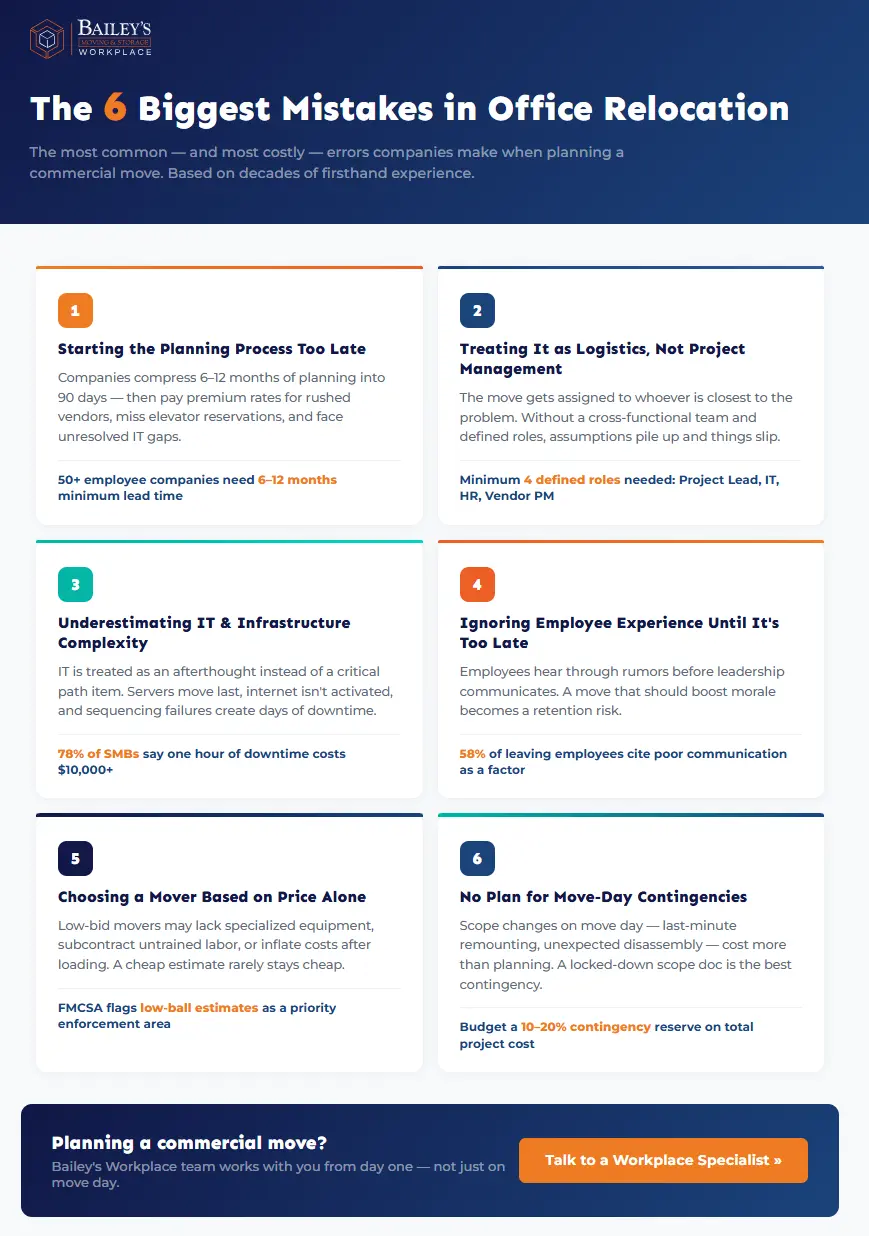
The six mistakes below are the specific reasons that pattern repeats.
Mistake 1
Starting the Office Relocation Planning Process Too Late
This is the most common mistake, and it cascades into every other one on this list.
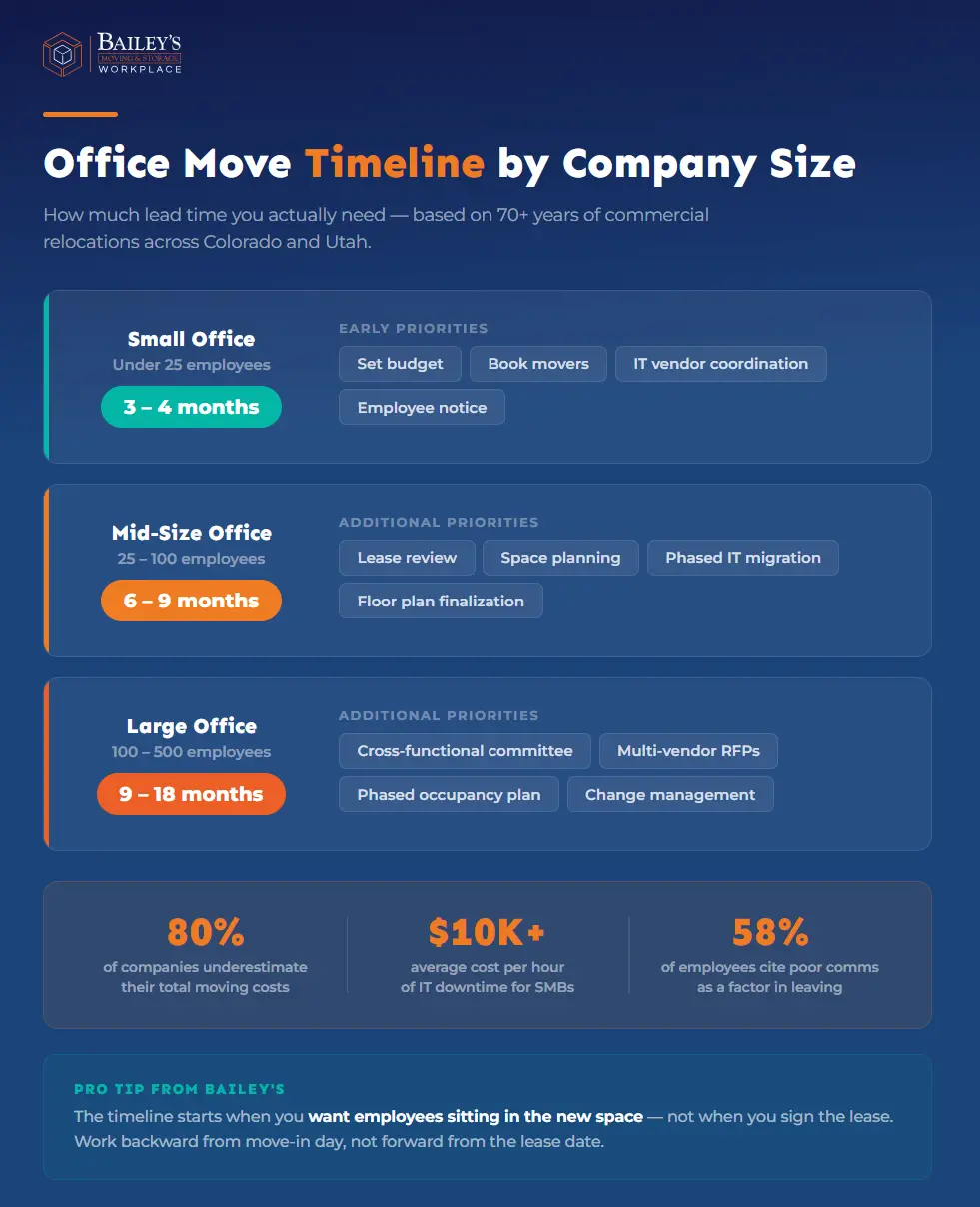
The industry consensus among commercial real estate advisors at JLL, Cushman & Wakefield, and Hughes Marino is consistent: companies with 50 or more employees need a minimum of six to twelve months of lead time before move day. Not six months from when you sign the lease — six months from when you want employees sitting in the new space.
Here's a rough guide by company size:
| Company size | Recommended lead time | Key early priorities |
|---|---|---|
| Under 25 employees | 3–4 months | Budget, movers, IT vendor, employee notice |
| 25–100 employees | 6–9 months | Above + lease review, space planning, phased IT |
| 100–500 employees | 9–18 months | Above + cross-functional committee, multi-vendor RFPs |
Most companies don't come close to hitting those windows.
What a Realistic Office Move Timeline Looks Like
JLL's commercial relocation checklist starts coordinating the move 24 weeks out — and the first items on the list aren't packing supplies. They're budget establishment, long-lead furniture procurement, and IT infrastructure audits.
Cushman & Wakefield structures their planning guide the same way: the six-to-four-month window is for lease obligation reviews, vendor selection, space planning, and IT audits. Hughes Marino adds a third phase — the final one to two months — for packing, labeling, and IT cutover rehearsals.
The companies that compress all of this into a 90-day window typically face premium vendor rates, missed elevator reservations, unresolved IT configurations, and employee communication breakdowns. And then they pay more to fix those problems than proper planning would have cost.
For a detailed week-by-week breakdown, JLL's office moving checklist is a useful reference point.
What "Starting Late" Actually Looks Like
Lincoln Kelley has seen this play out firsthand. "We can almost always get people out there to help," he says. "But the level of skill and quality you're going to get is very based on the lead time you give us. The more time you give us, the better we can get installers, A-team crew leads, project managers."
When companies come to Bailey's without enough runway, the math changes. "The later you give it to us, we're going to have to get guys that might primarily do household goods. They'll probably be B-team or C-team level quality. And a lot of times these bids are time and materials — so if those guys aren't familiar with how office furniture works or how the building works, it ends up taking a little more time and costing a little more money."
The other timing risk: peak season. Commercial moves — like residential ones — have busy periods. Waiting until the last minute doesn't just limit crew quality. It limits your options entirely.
Mistake 2
Treating It as a Logistics Problem Instead of a Project Management Problem
Most office moves get assigned to whoever is closest to the problem: the office manager, the facilities coordinator, or the admin who's good at organizing things. That person may be excellent at their job. But an office relocation isn't an administrative task — it's a cross-functional project with interdependent workstreams, vendor dependencies, and real financial consequences if something slips.
The Project Management Institute has documented this pattern extensively. Lack of clearly defined roles and decision authority is one of the top drivers of project failure across all project categories. An office move is no different.
Who Should Be in the Room for Your Office Move Project Plan
Lincoln's guidance on this is direct: the more people involved early, the better.
Not just the facilities managers and project managers and HR — those people matter — but I would say even managers of each department is beneficial. That way they can prep their employees during the move process and figure out how to keep them up and running while we're still moving all their stuff. — Lincoln Kelley
A well-run commercial relocation has at minimum four clearly defined roles:
- Internal project lead — owns the overall timeline, budget, and vendor relationships
- IT lead — owns the technology migration, sequencing, and cutover plan
- HR liaison — owns employee communication, change management, and commute/parking concerns
- Vendor project manager — your moving company's point of contact who coordinates building access, crew scheduling, and day-of execution
What the First Conversation Usually Looks Like — and Why That's a Problem
Lincoln is candid about what companies actually care about in that first meeting. "Most people are looking for budgetary numbers. They don't care as much for the logistics part of it. Even though when we walk the space and give them a budget, we kind of explain why each number is what it costs — most of the time they're looking for: is this in our budget? If it's in our budget, then we can have more conversations about X, Y, and Z."
That's understandable. But it means the project management conversation — who owns what, what the timeline actually looks like, which tasks belong to the client versus Bailey's — often gets delayed until after the budget conversation is resolved. That delay is where assumptions build up.
Bailey's addresses this with a detailed scope checklist sent with every contract. Every task in the move is assigned to a responsible party — Bailey's crew, the client's internal staff, or a third-party vendor. "That way we know who's doing what on the day of the move and there's not any overlap or expectations that we're going to do something that was never planned," Lincoln says.
Bracken Jones, Bailey's Chief Revenue Officer, takes it a step further. Beyond the written scope, Bailey's sends a representative onsite before move day to walk through the plan directly with the client's employees — not just the project lead. "Most companies send an email and consider that enough," Jones says. "We run a pre-move planning meeting to keep the move as efficient as possible." Employees learn where to place inventory stickers and how to label items so chairs, computers, and keyboards land in the right place without guesswork on move day. It's one of the details that separates a two-day move from a four-day one.
PMI research confirms that projects with defined contingency budgets are significantly less likely to experience cost overruns. For office relocations, the standard recommendation is a 10–20% contingency reserve on total project cost — higher for moves involving significant IT migration or renovation work.
Mistake 3
Underestimating IT and Infrastructure Complexity
Moving desks and filing cabinets is straightforward. Moving the systems those people depend on to do their jobs is not.
IT infrastructure is the most frequently underestimated cost category in commercial relocations. Mid-size office moves inclusive of IT setup typically run $50,000 to $120,000, with 20–25% of that budget consumed by technology alone. JLL's 2024 design trends and cost guide reported an 8.3% year-over-year increase in tenant technology and AV costs — a line item that rarely shows up in an initial relocation estimate.
The financial exposure from getting this wrong is significant. Datto research found that 78% of SMBs report a single hour of downtime costs them over $10,000. Industry-specific downtime costs run from $5,600–$7,200 per hour for retail and professional services, up to $22,000 per hour for manufacturing and distribution.
How to Sequence an Office Move When IT Is Involved
Lincoln walks through the sequencing Bailey's uses on commercial moves with significant technology components:
Typically the server part — their own IT department usually handles that. But that's usually the first thing that moves. That way they can set up the switches, the networking, make sure that's all good to go before we move other people over. — Lincoln Kelley
After the server infrastructure is established at the new location, IT disconnection of individual workstations happens next — monitors, keyboards, desktops — before the physical furniture moves. Bailey's then moves the furniture and workstations simultaneously, with setup happening on the back end.
Cubicles add another layer of sequencing. "Inside cubicles we run data cords in and out, so that happens simultaneously with the move. We'll disassemble the cubes, pull back the data and the WIPs, and then on the back end get IT people to run the data through the cubicles and the power, low volt, and get that connected."
Before any of this happens, the facilities manager needs to physically visit the new space. "It is very important for the facilities manager to go out to the new area and make sure that the cubes, the power, and the data are all going to fit in the space in the right place. That way we're not running wires across hallways."
What Gets Missed When IT Isn't at the Planning Table Early
The most common technology failures during office moves aren't caused by damaged equipment. They're caused by sequencing failures — IT is treated as an afterthought rather than a critical path item, and problems that could have been solved weeks earlier surface on move day.
The specific failure points that show up most often:
- Internet not activated before employees arrive. Fiber installations average 2–3 weeks. If you don't order service 6–8 weeks out, you're deploying mobile hotspots on day one.
- Phone systems not reprogrammed. Number porting and VoIP reconfiguration for new IP address ranges take time that isn't always accounted for.
- Network equipment not labeled. Switches and routers placed in a new space without a labeling system create hours of reconfiguration work.
- Server configurations lost or corrupted during physical transport without proper handling.
- Access control and security systems not transferred or tested before occupancy.
Austin Ducello, Commercial Relocation Expert at Bailey's, has watched this play out more than once. "We were supposed to move a server rack — all those servers needed to be disconnected, taken out, and properly packaged. Because the IT team wasn't looped in early enough, they were given a 48-hour heads-up notice. They weren't able to do everything on the cloud side of things before we just unplugged a bunch of servers. Their team was putting in 16-hour days trying to get it prepped and ready."
The downstream cost isn't just IT overtime. A move that was planned for a weekend stretches into the following week. Employees can't work. Revenue stops. "That has happened to me twice," Austin says.
His recommended minimum: IT needs to be looped in 60 to 90 days before the move takes place. That window matters even more when the company's primary IT expertise isn't local. "A lot of companies have an in-house IT person, but for moves, there may be a more experienced head of IT at headquarters — in Texas, California, Florida, wherever. Companies will fly that person in to assist. If planning isn't done months in advance, it's really hard to make sure you get the flights and hotels sorted, and that when they get on site they know exactly what they're doing. Most of the time, they have 72 hours on site for the week of the move. They need to get everything done and troubleshoot problems as they go."
Cushman & Wakefield places IT involvement at the six-to-four-month mark — auditing technology assets, identifying relocation needs, coordinating with the IT team before any vendor is selected. JLL lists IT as one of the first long-lead procurement categories, starting 24 weeks out. The field experience from Bailey's confirms what the frameworks say: when IT is an afterthought, it doesn't just delay the move. It can unravel it.
Mistake 4
Ignoring Employee Experience Until It's Too Late
Office moves can be genuinely positive for employees. A Clutch survey of 503 U.S. workers who had relocated with their employer found that 68% described the move as having a positive effect on them overall — with better space, more room to work, and improved aesthetics among the top benefits.
But that same survey found 67% also found the relocation challenging, and 30% described it as a distraction from their work. And one of the case studies in the research came from Fort Collins, Colorado: a company that lost employees because a three-week move stretched into three months, and the stress of that uncertainty drove people out.
The difference between a move that improves morale and one that accelerates turnover almost always comes down to communication.
What the Research Says About Communication and Retention
The Staffbase 2025 Employee Communication Impact Study — 1,044 U.S. employees surveyed with YouGov — found that 58% of employees considering leaving their jobs cited poor internal communication as a contributing factor. Only 38% of employees rate their company's communications as excellent or very good.
During a high-change event like an office relocation, that gap becomes a retention risk.
SHRM's 2025 State of the Workplace Research Report found that employee experience and engagement account for 42% of turnover intent. A poorly communicated office move isn't just an inconvenience — it's a measurable churn accelerator.
What to Tell Employees — and When
The consistent recommendation from HR and workplace consultants is to begin communication the moment the relocation decision is confirmed, not after planning is finalized. Employees who find out about a move through rumors before hearing it from leadership face one of the most preventable sources of resentment.
A phased communication approach:
- Initial announcement (as soon as the decision is made): Share the reason for the move, the anticipated timeline, and the expected impact on employees. Open a channel for questions.
- Monthly progress updates: What milestones have been hit, what decisions are still pending, how employee input is being incorporated.
- Final details (4–6 weeks before move day): Logistics, packing instructions, new address, commute options, building access, and a day-one guide.
- Post-move follow-up: A brief survey, a debrief with team leads, and visible responsiveness to punch-list issues.
More communication channels, started earlier, reduce anxiety and rumors. That's not complicated — it's just consistently skipped.
Mistake 5
Choosing a Commercial Moving Company Based on Price Alone
This one has teeth. The FMCSA explicitly identifies low-balling estimates as a violation under federal carrier regulations. The mechanism is straightforward: a mover provides a non-binding estimate set below actual costs, then presents a higher revised figure after goods are loaded — a point at which you have no practical leverage. Under the FMCSA's 110% rule, interstate movers on non-binding estimates can't demand more than 110% of the original before releasing goods, but the balance can be invoiced 30 days later.
Before signing anything, verify any commercial mover's USDOT number through the FMCSA Safer Web database.
The FMCSA's Operation Protect Your Move, a nationwide crackdown on moving fraud, flagged deceptive estimate practices as a priority enforcement area. HomeServices Relocation data shows moving industry complaints to the FMCSA's National Consumer Complaint Database rose significantly between 2020 and 2021.
For commercial clients specifically, the risks go beyond price inflation. Low-bid commercial movers may:
- Lack specialized equipment for server racks, conference room AV, or sensitive electronics
- Be unfamiliar with commercial building requirements — elevator reservations, loading dock windows, certificate of insurance requirements
- Subcontract labor without disclosing it, introducing untrained workers on your move day
- Have insufficient crew size for the scope, causing move-day delays that push into business hours
What a Full-Service Office Move Actually Includes
Bracken Jones, Chief Revenue Officer at Bailey's Moving & Storage, describes the difference plainly.
On every project, we spend time with each client to discuss the scope of work, and we attach that scope directly to our quotes and proposals. We want every client to clearly understand what will be covered so that, when move day comes, everyone is aligned and we can deliver exactly what the client expects. — Bracken Jones
That alignment process starts before a single box is packed. One thing Bailey's does that most movers don't: an onsite pre-move planning session with the client's employees. "Most companies send an email and consider that enough," Jones says. "We run a pre-move planning meeting to keep the move as efficient as possible." Employees learn where to place inventory stickers, how to label items correctly, and what's expected of them on move day. Because labor time drives cost in commercial moves, that preparation directly reduces the final invoice.
Beyond the planning process, Bailey's full-service commercial scope includes capabilities many movers can't offer in-house:
- Computer disconnect and reconnect — trained crews disconnect, label, move, reconnect, and set up systems for minimal client downtime
- Full building protection — Masonite running boards and wall protection, sized to the specific site
- Signage and wall-mounted item removal — whiteboards, displays, and mounted items removed, with fill, patch, and paint so the origin space is landlord-ready
- Clean sweep of the origin — full cleanup after the move so the client can turn the space back over immediately
- Excluded-items list on every proposal — clients know exactly what is and isn't covered before anyone commits
That last point matters more than it sounds. The gap between what a low-bid mover includes and what the client assumes is included is where commercial moves get expensive fast.
Questions to Ask Before Hiring a Commercial Office Mover
- What is your USDOT number? (Verify on the FMCSA Safer Web database before signing anything.)
- What commercial building moves have you completed in Denver or Salt Lake City? Ask for references from buildings with similar access restrictions.
- Do you subcontract any labor? If so, are subcontractors vetted and insured to the same standard?
- How do you handle elevator and loading dock reservations — and what's your plan if they conflict?
- Can you provide a binding not-to-exceed estimate?
- What is your claims process for damaged or missing equipment?
- What specialty handling do you provide for servers, monitors, and conference room AV?
- What is the crew size for our scope, and is overtime included in the contract?
Mistake 6
No Plan for Move-Day Contingencies and Scope Changes
The Project Management Institute describes contingency planning as a project management necessity — not a luxury. A PMI-published case study on the Rockwell International data center relocation explicitly called the move "a complex project with some risk of business interruption" and documented the necessity of pre-defined alternate processing strategies before a single piece of equipment moved.
Office relocations warrant the same treatment.
Standard contingency reserves for facilities projects run 5–10% for low-risk moves, 10–15% for medium-risk, and 15–20% for complex moves involving significant IT migration or renovation. If your office move involves extensive technology, phased occupancy, or a building with access restrictions, plan on the higher end.
What Actually Goes Wrong on Move Day
Building access is the failure point Lincoln flags first — and for good reason.
A lot of office spaces don't have docks, so we have to think about the best way to get all the furniture out of the building, as well as the time of day we're allowed to do it. A lot of landlords don't like movers in during business hours. — Lincoln Kelley
That constraint has to be surfaced and confirmed long before move day — not discovered when the crew arrives. In Bailey's final-week confirmation process, building access is the first item: dedicated freight elevator reservation, Masonite floor protection, carry distance from elevator to truck, and confirmation of after-hours or weekend access windows if the landlord requires it.
The real-world cost of skipping that confirmation: "There was one move for a fairly large bank," Lincoln recalls. "They were supposed to have their internal staff disconnect all of the monitors from the monitor arms. We got out there and they were all still connected."
Bailey's was able to get installers on-site and resolve it — but it cost an additional day. "That kind of slows things and potentially there's a domino effect. If it delays one part of it, then the rest of the project's a little bit behind."
The Real Contingency Risk: Scope Changes on Move Day
Austin Ducello offers a reframe that's worth sitting with. "Most contingencies are changes of scope," he says. "Making sure that you have given your estimator, your moving company, a very detailed scope of what we are doing — and sticking to that, being married to that, not changing that — is the best way to make sure a move goes smoothly. If you do changes of scope the day of the move, typically those can be pretty expensive. And on top of that, it can delay the move-in and delay how quickly you can get back up and running."
He's seen this firsthand. A 30-employee office move, roughly 20 desks with panel walls between them. The panels were going to be disposed of; the desks were moving to the new location. Straightforward enough — until move day.
"Our crew was not ready to start disassembling all these desks from these panel walls. And then on top of it, the customer told the crew that once these desks arrived at destination, they wanted all of them mounted to the wall. Are we going to be able to mount directly into a stud? Do we need brackets? We were just not ready for that."
Same job, same morning: the client had previously said no TV dismounting or remounting. "When we showed up, she said: by the way, we changed our mind — we want you to dismount this TV and remount it. Because we didn't have a contingency plan in place, we didn't come prepared. The tools we brought weren't going to work to remount. Those problems ended up costing the customer more money."
Austin's conclusion: "Most moving companies are not good at dealing with issues on the fly. Yes, we pitch ourselves as pretty flexible. But most of the time, if it doesn't go the exact way we think it's going to go, it ends up costing the customer more money."
The practical protection against this isn't a backup plan — it's a locked-down scope document that every stakeholder has reviewed and signed off on before move day. Changes are expensive. Surprises are more expensive.
Confirm elevator reservations, loading dock windows, and building access 72 hours before move day — not the morning of. And confirm the scope one more time while you're at it.
Frequently Asked Questions About Office Relocation Planning
How far in advance should you start planning an office move?
For companies with 50 or more employees, the industry consensus is six to twelve months. Smaller offices can work with three to four months, but only when building access, floor plans, and IT planning are already resolved. Compressing the timeline below 90 days typically results in premium vendor rates, IT failures, and preventable move-day disruptions.
What should be included in an office move project plan?
A complete office move project plan covers scope definition, a milestone calendar, vendor coordination, budget tracking with contingency reserve, IT sequencing, an employee communication plan, and move-day contingency protocols. Assigning a dedicated internal project lead — separate from the person managing day-to-day operations — is the single structural decision that most directly predicts project success.
How do you minimize downtime during an office relocation?
Three things reduce downtime more than anything else: looping in your IT team at the six-month mark (not the final weeks), ordering internet service 6–8 weeks before move day, and dry-running critical systems at the new space before employees arrive. After-hours and weekend moves, when available, also protect business continuity by keeping the disruption outside operating hours.
What does office relocation project management include?
Beyond coordinating trucks and crew, professional office relocation project management includes pre-move site surveys, building access coordination, IT sequencing, furniture layout planning, and a structured task checklist that assigns every responsibility — to Bailey's, to the client's internal staff, or to a third-party vendor — before move day. The difference between project management and logistics coordination is accountability for outcomes, not just task completion.
How do I find a reliable commercial moving company in Denver or Salt Lake City?
Start by verifying the company's USDOT number through the FMCSA Safer Web database. Ask specifically for commercial building references — preferably in buildings with similar elevator or loading dock constraints. Request a binding not-to-exceed estimate. And ask directly whether any labor will be subcontracted, and under what insurance coverage.
Good Office Relocation Planning Is What Makes It Seamless
Denver and Salt Lake City are both in market conditions that favor tenants right now. Companies that have been waiting for the right space, or the right terms, have real options. The operational work of getting the move right deserves the same attention as the lease negotiation.
Most of these mistakes are preventable. They require lead time, a real project plan, clear ownership of who does what, and a commercial mover who shows up with a checklist — not just a truck.
If you're planning a commercial relocation in Colorado or Utah, Bailey's Workplace team works with your internal project lead from day one — not just on move day.