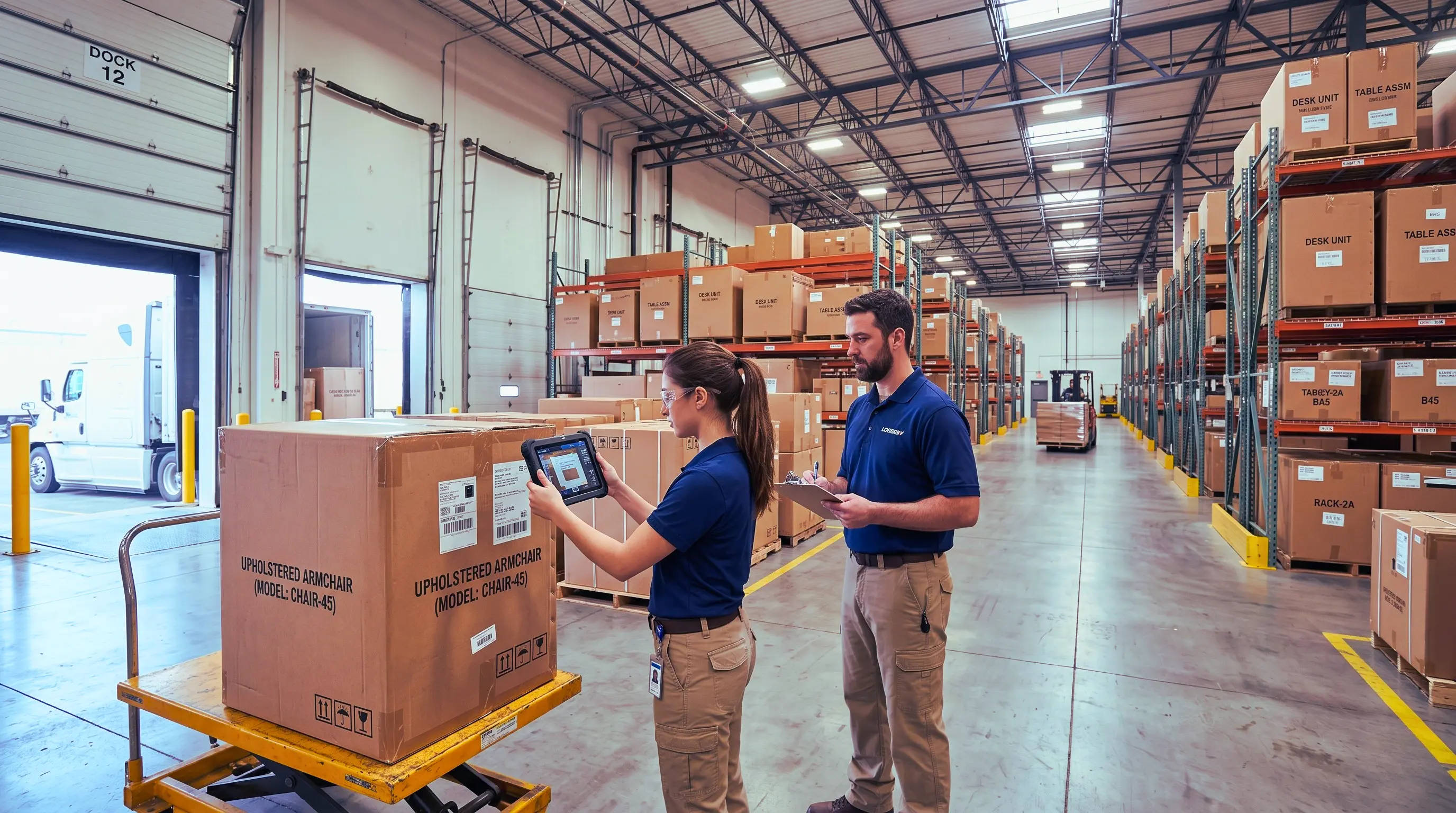
The logistics decisions you make before the first purchase order ships determine whether your commercial project opens on schedule — or spends its final weeks in recovery mode. This guide covers the complete six-phase service chain, cost benchmarks by project type, the five failure points that compound fastest, and the questions that separate a purpose-built FF&E logistics partner from a generalist who will get you into trouble at the worst possible moment.
A 130-room hotel under construction. The general contractor had decided to self-perform the guest room furniture installation to save money. When it came time to install, the elevator permits hadn't been approved — every bed, sleeper sofa, and credenza destined for the upper floors had nowhere to go.
The call came to Bailey's. Their solution: source a boom lift from the contractor, remove the windows at the end of each upper floor, and hoist the furniture directly into the building from outside. The project stayed on schedule. A potential two-week delay — and roughly $150,000 in lost opening revenue — was absorbed before it could compound.
That's not a horror story. It's a typical one. Vendors ship when they're ready. Construction runs behind. Permits don't clear. Problems on commercial FF&E projects aren't exceptional — they're structural. The question is never whether they'll surface. It's who's equipped to handle them when they do.
FF&E logistics is the coordinated process of receiving, warehousing, staging, and installing furniture, fixtures, and equipment for commercial projects — from the moment a purchase order is placed to the day a space opens. This guide is for the project managers, facilities managers, FF&E coordinators, and interior designers who own that timeline. Whether you're outfitting a 200-room hotel, a corporate headquarters, or a healthcare facility, the logistics decisions you make early determine whether you open on schedule or spend the final weeks in recovery mode.
- FF&E logistics is a six-phase discipline — not just delivery — spanning pre-order coordination through punch list close-out.
- Logistics typically costs 6–25% of total FF&E product spend; hospitality and healthcare run highest due to project complexity.
- Skipped receiving inspection is the single most common — and most expensive — logistics failure on commercial projects.
- Specialized FF&E partners differ from general movers on six key capabilities: receiving inspection, dedicated warehousing, real-time inventory, installation, GC coordination, and single-point accountability.
- Engaging a logistics partner before purchase orders are cut — not after shipments begin arriving — eliminates the most project risk.
What FF&E Logistics Actually Involves
Before anything else, let's be precise about what we're talking about.
FF&E vs. OS&E — Why the Distinction Matters
FF&E — furniture, fixtures, and equipment — refers to the moveable items that furnish and outfit a space: guest room furniture, lobby seating, workstations, case goods, lighting fixtures, built-in shelving, kitchen equipment. These items are typically specified by a designer, purchased through a dealer or procurement firm, and shipped from multiple manufacturers on independent timelines.
OS&E — operating supplies and equipment — covers the consumables and operational items a facility needs to run: linens, cookware, uniforms, cleaning supplies. OS&E arrives at or near opening and is usually managed separately from the furniture program.
The distinction matters because the logistics of each are completely different. OS&E is relatively simple to receive and distribute. FF&E requires receiving inspection, long-term warehousing, careful inventory management, and installation by trained crews. Mixing up responsibility for the two — or assuming the same vendor can handle both — is a common source of coordination gaps on complex projects.
Why FF&E Logistics Is a Discipline, Not a Delivery
The default assumption many buyers bring to FF&E is that it's essentially a delivery problem: hire someone with trucks, get the furniture from point A to point B, done.
What it actually involves is closer to project management than transportation. A typical commercial FF&E project spans six to eighteen months from first purchase order to punch list. Thirty or more vendors are often shipping on their own timelines. The installation site is usually an active construction zone with limited access, competing trades, and a fixed opening date that doesn't move.
A freight carrier can get a shipment to your dock. What it can't do is receive that shipment and document its condition, hold it in a climate-controlled warehouse for months, coordinate with your GC on a floor-by-floor delivery sequence, manage elevator scheduling with the building, install systems furniture and case goods to spec, and hand you a completed punch list. That's a different category of service entirely.
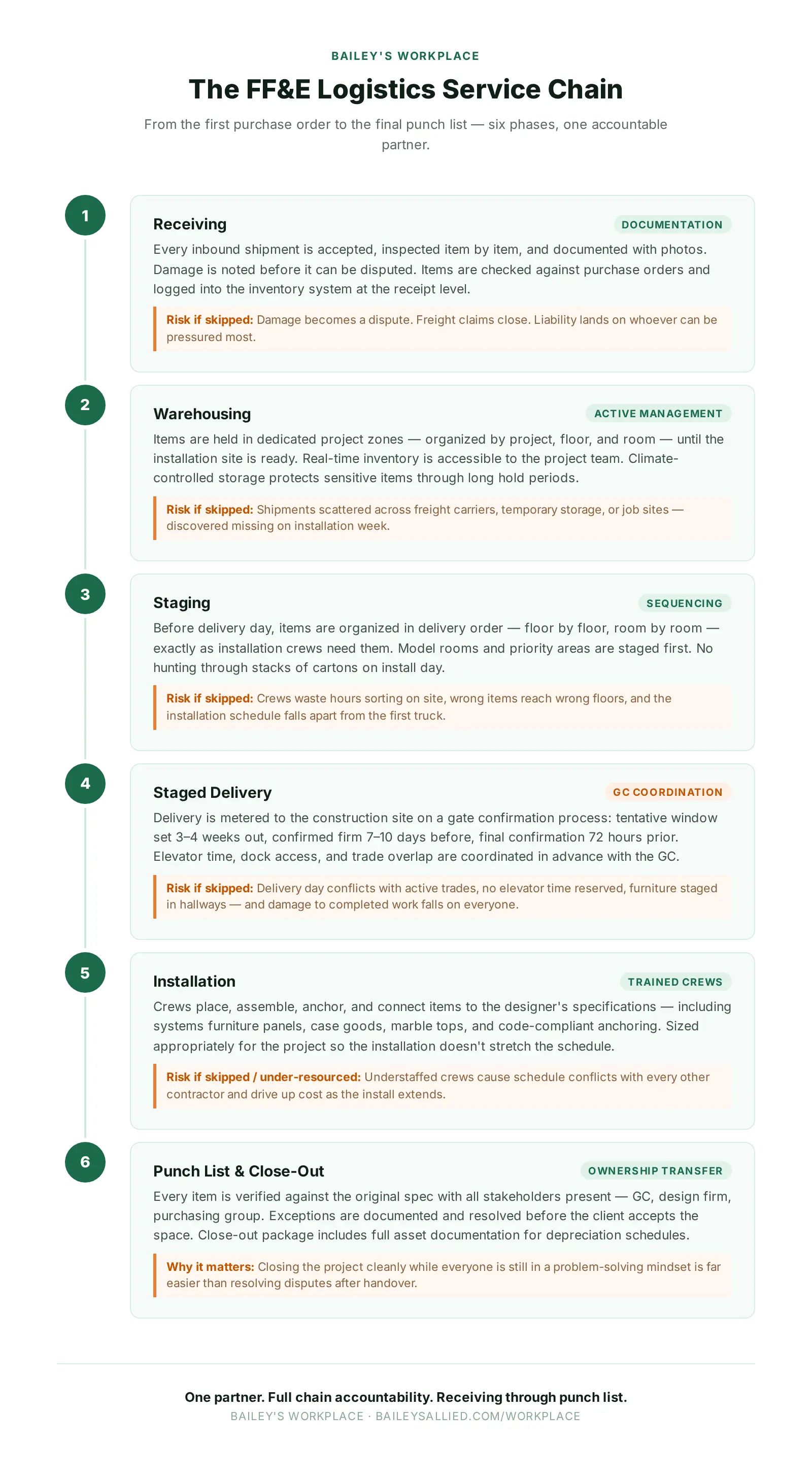
The Full Service Chain: Receiving → Warehousing → Staging → Installation → Punch List
A full-service FF&E logistics partner handles the entire chain:
Receiving: Every inbound shipment is accepted, inspected, and documented. Damage is noted before it can be disputed. Items are checked against purchase orders and logged into inventory.
Warehousing: Items are held in a dedicated project warehouse — not a shared general storage facility — until the installation site is ready. Cross-dock management keeps short-term items moving; long-term holds are tracked and accessible to the project team.
Staging: Before delivery day, items are organized in delivery sequence so they arrive floor by floor, room by room, in the order installation crews need them.
Installation: Crews place, anchor, assemble, and connect items according to the designer's specifications and any applicable code requirements.
Punch list: After installation, every item is verified against the original spec. Damage, missing pieces, and substitutions are documented and resolved before the client accepts the space.
Each of these handoffs is a risk point if ownership isn't clearly defined. The job of a logistics partner is to own the chain — not to hand pieces of it off between vendors.
Ron Hougland, Bailey's General Manager of Distribution, describes what that receiving process looks like from the inside.
"It always starts at the bay door — and it's usually a surprise. We hardly ever have leading indicators of what's coming."
— Ron Hougland, General Manager of Distribution, Bailey's Workplace
When a truck backs up, the team reviews whatever paperwork the driver has — a physical bill of lading, a digital form, sometimes nothing — and begins inspecting the outside of every item as it's being offloaded. The driver handles the product for as long as possible: liability and ownership transfer at the point of signing, so Bailey's makes sure the driver's hands stay on the freight until that moment.
If there's damage on the outside of a carton — or anything audible, like loose pieces rattling inside — that exception is noted on the driver's bill of lading and proof of delivery. A copy is made, photos are taken, and a report goes immediately to Bailey's customer service coordinator. She notifies the customer directly, with full documentation. "We want the customer to have all the detail as if they were here experiencing it for themselves," Ron said.
Every shipment is received — never refused. As a third-party warehouse, refusal creates liability complications; thorough documentation is how exceptions get handled. Once an item clears the dock, it's logged into the warehouse management system at the receipt level and scanned to its designated project location.
The FF&E Project Coordination Lifecycle — Phase by Phase
Understanding what happens at each phase is the foundation for making smart decisions about logistics. Here's what a well-run FF&E project looks like from the inside.
Phase 1 — Pre-Order Coordination and Vendor Alignment
The biggest mistake project teams make is waiting until furniture starts shipping to engage a logistics partner. By that point, they're reacting. The best outcomes happen when the logistics partner is brought in before purchase orders are cut.
Early engagement means your warehouse partner knows what's coming, from whom, and approximately when. They can flag lead time issues, identify vendors with inconsistent shipping histories, and configure an inventory system before the first box arrives.
For hospitality projects specifically, early coordination is what makes hotel room sequencing possible. Each room needs to be furnished identically but numbered correctly. Model rooms need to be completed first for ownership and brand approval. If the logistics partner doesn't know the room numbering schema before receiving begins, they're sorting it out later — under pressure, with a hard opening date approaching.
Bailey's inventory system is configured before the first shipment arrives. As soon as a piece comes into the warehouse, the crew logs it with photos, condition notes, and damage documentation — all accessible online within 24 hours.
Chris Schuh, a Commercial Relocation and FF&E Specialist with Bailey's, explains why that window matters:
"Customers can pull up every detail — condition, photos, damage notes. With other companies, you just get shipping sheets. They don't know there's damage until move-in day. And that's too late to order a replacement that's six weeks out."
— Chris Schuh, Commercial Relocation and FF&E Specialist, Bailey's Workplace
That last point is the critical one. FF&E lead times from many manufacturers run six to twelve weeks. A damage discovery at installation isn't just an inconvenience — it's a replacement order that can't be expedited and a schedule that's suddenly at risk.
Which is exactly why what happens at the receiving dock — before anything goes into storage — is the most consequential step in the chain.
Phase 2 — Receiving, Inspection, and Damage Documentation
Every shipment that arrives at the warehouse gets inspected before it goes into storage. Not glanced at — opened, checked against the purchase order, and documented with photos if there's any damage or discrepancy.
This step is the one most often skipped by providers who aren't built for FF&E. And it's the one that costs the most when it's missing. Damage that isn't documented at receiving becomes a dispute at installation. By then, months have passed, multiple vendors have touched the item, and nobody can prove where the damage occurred.
Light fixtures are the highest-damage category on most FF&E projects. Glass, marble tops, and mirrored furniture follow closely. These aren't surprises — they're predictable, and a competent receiving process accounts for them specifically.
Experienced receivers know where to look beyond the obvious.
"If there's a marble top in a slat crate, we know to cut the foam open and find out why. Our experience tells us what to look for."
— Chris Schuh, Commercial Relocation and FF&E Specialist, Bailey's Workplace
That kind of proactive inspection — not just checking what's visible, but anticipating what a specific packaging type might be hiding — is what separates a trained FF&E receiving team from a crew that's signing for boxes.
From Ron Hougland's experience running Bailey's receiving operation: roughly 10% of inbound FF&E shipments show some form of external exception — a hole in a box, tape torn and re-taped, anything that signals the carton didn't travel in perfect condition. Of those, about 1% reveal actual product damage when opened and inspected.
The most common damage categories: heavy or oversized items shipped loose on LTL — they've been mishandled the most in transit. Furniture on economy cardboard pallets with insufficient strapping, which breaks at the strapping point when lifted. And artwork, mirrors, and glass pieces that are light enough to get shoved into trailer nooks to maximize space.
"When we receive that type of product, we're very careful — because some artwork is extremely expensive and you would never know unless you're handling it with care."
— Ron Hougland, General Manager of Distribution, Bailey's Workplace
By the time FF&E reaches a receiving warehouse, it's typically been handled six to twelve times since leaving the manufacturer. Each handoff is a point where damage can occur — and a point where documentation gaps accumulate if the receiving process doesn't close them.
Once items are documented and cleared, they need somewhere to live — sometimes for months. What that facility actually is matters more than most buyers realize going in.
Phase 3 — FF&E Warehousing, Inventory, and Cross-Dock Management
Project warehousing is not the same as storage. The distinction matters more than most buyers realize.
A storage unit holds things. A project warehouse manages them — actively tracking what arrived, when, in what condition, where it sits in the facility, and when it ships. For a large FF&E project, the warehouse is essentially a staging environment for the entire installation.
Bailey's Workplace FF&E operations hold more than 200 projects, with north of a couple million pounds of FF&E inventory moving in and out each year. That scale requires dedicated project zones, real-time inventory tracking, and a system that a designer or coordinator can access from their office when they need to know whether a specific shipment has cleared.
Cross-dock projects — where items arrive and ship out quickly without long-term storage — are managed differently from projects with extended holds. Both are common, and a well-run warehouse operation handles both without mixing them up or losing accountability across the transition.
Keeping inventory clean in the warehouse is its own discipline. Getting it to the right floor of an active construction site, on the right day, without colliding with active trades — that's an entirely different one.
Phase 4 — GC Coordination and Staged Delivery Sequencing
This is where most FF&E projects either work or fall apart.
The general contractor runs the construction schedule. FF&E delivery has to fit inside it — which means coordinating elevator access, staging space on the floor, completion sequence, and the daily movements of active trades still finishing work on other levels.
A well-run delivery sequence follows a gate process: a tentative delivery window set three to four weeks out, confirmed as firm seven to ten days before, with a final confirmation 72 hours prior. Each stage gives the GC time to flag conflicts and gives the logistics team time to re-sequence without chaos.
When that gate process doesn't exist, you get deliveries arriving at construction sites where there's no reserved elevator time, no staging space, and active trades working in the rooms where installation needs to happen.
Here's what that actually looks like in practice.
Kasey Knowles, a Commercial Relocation Specialist with Bailey's, describes a hotel project that shows exactly how fast things can cascade. A GC on a new hotel build — around 130 guest rooms — decided to have their own crew handle guest room furniture installation to save money. Construction ran behind schedule. When it came time to install, the elevator permits hadn't yet been approved.
"The construction got delayed and they got into a time crunch. They didn't have permits for the elevators yet — so the second, third, fourth floors, they were thinking: are we going to have to haul all the guest room furniture up the stairwell?"
— Kasey Knowles, Commercial Relocation Specialist, Bailey's Workplace
Bailey's got the call. Their solution didn't involve waiting for elevator permits to clear. They sourced a boom lift from the contractor, had windows removed at the end of each upper floor, and hoisted the furniture — beds, sleeper sofas, credenzas — directly up to each floor from outside the building.
"We were able to get a boom lift from the contractor, have the window removed on the upper floors, and use the lift to get the guest room furniture up to those higher floors. It saved a ton of time and a ton of money."
— Kasey Knowles, Commercial Relocation Specialist, Bailey's Workplace
The project stayed on schedule. Without that intervention, Kasey estimates the delay would have run one and a half to two weeks.
Getting into the building is one challenge. What happens once the crew is on the floor — and how well they're resourced for it — determines whether that schedule holds through to completion.
Phase 5 — Installation, Trade Coordination, and Day-One Readiness
Installation is more than placement. On a commercial FF&E project it means assembling case goods, anchoring shelving and bookcases per code, attaching marble tops with adhesive that needs time to cure, connecting systems furniture panels, and often working around active trades finishing adjacent rooms.
Crew sizing matters here. Understaffing an installation doesn't just slow things down — it creates conflicts with every other contractor in the building and drives up cost as the schedule extends.
When trades overlap on an active site, coordination breaks down fast. Elevator time becomes a negotiation. Rooms that are "ready" often aren't. The calculus almost always favors paying for an extra month of storage over trying to squeeze an FF&E install into a building that isn't ready for it.
When the building is ready and the installation complete, most project teams exhale — which is exactly when the most important step in the project tends to get treated as an afterthought.
Phase 6 — Punch List, Close-Out, and Warranty Items
The final walkthrough isn't just a checklist — it's a transfer of ownership. From the moment product arrives at the dock, it's in the logistics partner's custody. The punch list is the moment that officially changes hands.
Ron Hougland, Bailey's General Manager of Distribution, treats the final walk as a formal event:
"I always have my notebook. Everything is written down. At the end, I send an email with all parties — the minutes of our final walk."
— Ron Hougland, General Manager of Distribution, Bailey's Workplace
Who's in the room matters as much as the process.
"You should do that final walk with as many stakeholders as you can — the GC, the design firm, the purchasing group. If something's missing, it touches three people. If something's damaged, it involves three people. You don't want to play telephone after the fact."
— Ron Hougland, General Manager of Distribution, Bailey's Workplace
The walk goes room by room. Common exceptions: outstanding pieces that hadn't arrived by install day, fabric with minor fraying or fitment issues, and damage to items in spaces where active trades — painters touching up, electricians finishing work — were still in the building during installation. Any contractor still present gets noted.
The goal isn't just to close the project cleanly. It's to close it while everyone is still in a problem-solving mindset.
"We want to answer questions when people are curious — not when they're frustrated."
— Ron Hougland, General Manager of Distribution, Bailey's Workplace
Documentation at this stage also matters for facilities teams tracking assets for depreciation schedules and future replacement cycles. A detailed close-out package is worth more than it looks like at the time.
Where FF&E Projects Break Down — The Most Common Failure Points
Most FF&E problems don't happen because of bad luck. They happen because of predictable gaps in how logistics were set up — and they compound. A shipment arrives uninspected and damage goes unrecorded. Months later, that damage surfaces during installation and becomes a dispute no one can resolve. The replacement order takes six weeks. The opening date moves. Every contractor in the building gets pushed, and the costs pile up in every direction.
The five failure points below aren't independent. They're a sequence — and most troubled projects contain more than one.
No Inspection at Receiving
When freight arrives and goes straight into storage without inspection, damage becomes a dispute. A chip on a marble top might have happened at the factory, in transit, or in the warehouse — without documentation at receiving, there's no way to know.
Freight carriers have limited liability once delivery is signed for. If damage isn't noted on the delivery receipt, proving a claim becomes significantly harder. By the time it's discovered at installation, the window for a clean freight claim has often closed — and the cost falls on whoever can be pressured most.
That inspection gap gets harder to manage with every additional vendor in the mix — and on a complex FF&E project, there are a lot of them.
Vendors Shipping on Their Own Timeline
Every manufacturer ships when their product is ready. That's reasonable from their perspective. From your project's perspective, it means thirty different shipments arriving at unpredictable intervals — some months before the site is ready, some after.
Without a receiving warehouse and an active inventory system, those shipments get scattered: some with the freight carrier, some in temporary storage, some delayed and undiscovered until installation week when the missing item becomes a critical problem.
When inventory is scattered and untracked, the next problem becomes almost inevitable: showing up at a construction site that isn't ready for you — with no one who knows what's coming or when.
GC Coordination Gaps — Elevator Access, Trade Overlap, Staging Space
Getting onto an active construction site with a full truckload of furniture requires more than a delivery appointment. It requires elevator time, a designated staging area, and a floor that's actually ready for furniture. When those aren't confirmed in advance, delivery day becomes a problem for everyone on site.
Pushing FF&E installation into a site that's still under construction doesn't just slow things down — it puts completed work at risk. Trades finishing electrical work in a room where FF&E installation is underway create conflict. Furniture in a hallway blocks other contractors. When something gets damaged in the overlap, accountability disappears.
The cost of an extra month of storage is almost always lower than the cost of recovering from a site-conflict disaster.
None of those conflicts can be managed well without real visibility into what's in the warehouse, what's en route, and what's still missing. Which is where the next gap appears.
Inventory Without a System
Spreadsheets break down on FF&E projects. The volume of items, the number of vendors, and the duration of the project create complexity that manual tracking can't reliably handle at scale.
When a designer asks what arrived this week and the answer requires calls to the warehouse, the freight carrier, and a search through email threads, the project is already behind. Real-time inventory access — where a coordinator can log in and see what's in stock, in what condition, and when it ships — isn't a luxury on a complex project. It's the baseline expectation for a partner who's actually managing the project rather than just storing things.
When providers switch mid-project without a proper inventory handoff, that traceability is gone. Re-inventorying takes time, and the gaps it reveals are expensive.
There's a deeper problem that exists even when a system is in place: naming conventions. A customer calls a piece a "side chair pearl." The vendor's SKU is "SK800." The box is labeled with something else. Bailey's inventories what's on the box.
"The biggest miss is unified information. The customer has a naming convention, the vendor has a naming convention, the manufacturer has a naming convention — and then we have ours. When they ask for a Darwin golden clock with black hands and we have it inventoried as a target clock, the customer feels like they've been let down. We're frustrated because we didn't have the right information to begin with."
— Ron Hougland, General Manager of Distribution, Bailey's Workplace
The fix is alignment before receiving starts — not a better search function. A reliable logistics partner pushes for a shared naming convention between the designer, dealer, and warehouse before the first PO ships.
Documentation precision also protects the client from liability that belongs elsewhere. Ron describes a case where a shipper claimed to have delivered a $30,000 chandelier. The tracking number matched — but what was physically in the shipment was 24 boxes of automotive clips. Bailey's inventoried exactly what arrived, labeled exactly as it was labeled, without assuming it was a chandelier because the customer expected one.
Months later, when the project delivered out, the customer received automotive clips instead of their chandelier. Every finger pointed at the warehouse — until the documentation proved otherwise.
"We never received the chandelier. Because we were very diligent in recording what was actually received, we had deniability."
— Ron Hougland, General Manager of Distribution, Bailey's Workplace
That's documentation working as it should — not just to catch damage, but to protect everyone in the chain from liability that belongs somewhere else.
But documentation only helps when there's someone who owns it. When logistics is split across three vendors who've never worked together, that ownership doesn't exist — and the disputes that follow are almost impossible to resolve cleanly.
No Single Point of Accountability (The Finger-Pointing Problem)
If your freight carrier, your warehouse, and your installer are three separate vendors, damage becomes a loop. Each vendor points to the next. Nobody owns the outcome.
A single-point logistics partner changes that dynamic entirely. One vendor receives, stores, stages, delivers, and installs. If something is wrong, there's one call to make and one party accountable for resolution. That accountability structure doesn't just make problem-solving easier — it changes how the provider behaves throughout the project, because they know they can't hand the problem to someone else.
The Three Tiers of FF&E Logistics Providers
Not every project needs the same level of logistics support. Understanding what each tier can and can't do is one of the most important decisions a project team makes early on.
Tier 1 — LTL Freight: Built for Transit, Not for White-Glove
Less-than-truckload freight carriers are cost-effective for getting individual shipments from manufacturer to destination. They're built for transit efficiency, not project logistics.
An LTL carrier delivers to your dock or threshold. They won't inspect at receiving, manage long-term storage, coordinate with your GC, or install anything. Their liability coverage for damage is based on weight and commodity class — not actual replacement value. For high-value FF&E items, that gap is significant.
Tier 1 works for simple, low-complexity shipments where the buyer is equipped to handle everything downstream. It's not a logistics strategy for a multi-vendor, multi-phase commercial project.
Tier 2 — General Commercial Movers: More Capacity, Same Accountability Gap
General commercial movers have trucks, crews, and storage space. They handle office relocations, equipment moves, and large-scale commercial work. But "commercial" doesn't automatically mean they're built for FF&E.
The gaps typically show up in the same three places: receiving inspection (often skipped), inventory technology (usually nonexistent), and installation experience (limited to placement rather than assembly or code-compliant anchoring). Scheduling availability becomes a problem on projects with long timelines and multiple delivery phases.
The crew quality gap is real too, and it shows up in ways buyers don't always connect back to their logistics choice. Chris Schuh on what using untrained labor actually looks like:
"Temp workers don't have the right equipment — no dollies, no walk boards. They don't know how to handle items without damaging them or how to open a box without cutting into what's inside."
— Chris Schuh, Commercial Relocation and FF&E Specialist, Bailey's Workplace
The resulting damage doesn't always look like damage at the time. It shows up at installation, or in the first year of use, or when a piece that wasn't properly assembled starts to fail.
"There's definitely always that option, and a lot of times customers will go that route thinking they may save on costs. But there are so many things that could go wrong with inexperienced movers."
— Kasey Knowles, Commercial Relocation Specialist, Bailey's Workplace
Tier 3 — Specialized FF&E Partners: Single-Point Ownership
A specialized FF&E logistics partner is built specifically for this category of work. That means dedicated warehouse infrastructure, inventory technology with client-facing access, installation crews trained on specific product types, active GC relationships, and single-point accountability across the full chain.
"You might spend a little more going with a professional, but you avoid so much stress, so many problems. One thing goes wrong and it pushes everything back — and then you have an even bigger problem."
— Kasey Knowles, Commercial Relocation Specialist, Bailey's Workplace
The difference between Tier 2 and Tier 3 isn't always visible in a quote comparison. It shows up when something goes wrong — and something always does.
Matching Provider Tier to Project Complexity
When Tier 1 or Tier 2 is workable:
- 1–3 vendors shipping directly to the installation site
- No warehouse hold required
- Simple item placement (no assembly, no anchoring)
- Flexible delivery window
- Single-floor or single-room scope
When Tier 3 is the right call:
- 10 or more vendors shipping on independent timelines
- Storage duration of one month or longer
- Assembly, anchoring, or systems furniture installation required
- Active construction site with elevator scheduling and GC coordination
- Fixed opening date with no buffer
Provider Capability Comparison
| Capability | Tier 1 — LTL Freight |
Tier 2 — General Commercial Mover |
Tier 3 — Specialized FF&E Partner |
|---|---|---|---|
| Receiving Inspection | ✗ | ⚠ Inconsistent | ✓ Full documentation + photos |
| Dedicated Warehousing | ✗ | ⚠ General storage only | ✓ Project-based, climate-controlled |
| Real-Time Inventory | ✗ | ✗ | ✓ Client-accessible portal |
| Installation Capability | ⚠ Threshold drop only | ⚠ Placement only | ✓ Assembly, anchoring, systems furniture |
| GC Coordination | ✗ | ⚠ Limited | ✓ Active gate process, phased delivery |
| Single-Point Accountability | ✗ | ✗ | ✓ Receiving through punch list |
What FF&E Logistics Costs — and How to Budget for It
The cheapest logistics bid is often the most expensive outcome. That principle is worth establishing before the numbers, because cost benchmarks invite comparison shopping — and comparison shopping on logistics is where projects quietly get into serious trouble.
Cost Benchmarks by Project Type
Source: Move Solutions FF&E Logistics Overview. Ranges vary by project complexity; see notes below.
- Commercial office: 8–15% of FF&E product cost
- Hospitality: 12–20%
- Healthcare: 15–25%
- Multifamily: 6–12%
Hospitality runs higher because of the complexity: multi-floor staging, strict room sequencing, and opening dates that leave no margin for error. Healthcare runs highest because of compliance requirements, careful sequencing around active patient areas, and near-zero damage tolerance on clinical furniture and equipment.
These are ranges, not quotes. What moves your number within the range: number of vendors, storage duration, floor count, site access complexity, and whether you're doing a phased build-out or a single install event.
What's Typically Included vs. Billed as Extra
A standard full-service scope covers receiving, warehousing through the agreed storage window, staged delivery, and installation to spec.
What generates additional costs:
- Extended storage beyond the original schedule (construction delays are the most common driver)
- Re-delivery when a site isn't ready at the scheduled time
- Overtime for installations that run long due to site conflicts
- Damage handling for items that need remediation or replacement coordination
- Change orders when project scope shifts significantly from what was bid
Change Orders: When They Happen and How to Reduce Them
On larger projects, logistics bids are submitted against blueprints and specs before the site exists. The scope gets priced on what's known — floor plans, furniture specs, estimated timelines. What can't be priced accurately is what can't be seen yet: actual elevator capacity, site access constraints, trade schedules, construction delays.
Most experienced procurement firms build a buffer into their logistics budget for this reason. Whether the buffer covers the overrun depends on how far the project drifts from the original bid. Change orders aren't automatically a sign something went wrong — they're often the honest adjustment when a project evolves significantly from what was originally scoped.
What reduces exposure: engage your logistics partner early, share construction schedule updates in real time, and give them access to the GC's project management platform when possible.
The Hidden Costs of Getting It Wrong
When a project runs into problems because of inadequate logistics — damaged items, missed deliveries, site conflicts — the recovery costs compound quickly. Here's what that math actually looks like.
For hospitality projects, the math is stark. The hotel Kasey Knowles described — a 130-room property where a GC's decision to self-perform installation ran into an elevator permit problem — could easily have resulted in a one-and-a-half to two-week delay. At approximately $15,000 per day in lost revenue for a 100-room hotel (based on a $150/night average daily rate — Armstrong Logistics), a 10-day delay represents roughly $150,000 in revenue that doesn't come back.
"It adds up quick."
— Kasey Knowles, Commercial Relocation Specialist, Bailey's Workplace
That figure doesn't include extended crew time, contractor delays, damage to completed work, or the reputational cost of a missed opening with ownership, operators, and pre-booked guests already in the system.
The pattern plays out consistently across project types. As Chris Schuh put it:
"That's why people leave us for money. And then they come back to us because of the quality — and they say, okay, I guess that's worth it."
— Chris Schuh, Commercial Relocation and FF&E Specialist, Bailey's Workplace
The return happens after the recovery costs show up: damaged items, re-deliveries, extended crew time, or a missed opening date that someone has to explain to ownership.
For office and corporate projects, the cost looks different: productivity loss from delayed move-in, extended lease overlap on the prior space, and the management time absorbed by a project that won't close cleanly.
Want a head start on your next project? Download the FF&E Project Logistics Checklist — covers pre-order setup, receiving, warehousing, staged delivery, install day, and punch list.
Download the free checklist →FF&E Logistics by Project Type
Hospitality — Hotels, Resorts, and PIP Projects
Hospitality is the most logistics-intensive FF&E category. Opening dates are fixed and tied directly to revenue. Every room is a unit of income, and every day a room isn't available is a day it can't earn.
The complexity is layered. A 200-room hotel may have 30-plus vendors shipping on independent timelines. Guest rooms need to be furnished identically but sequenced by floor and room number. Model rooms get completed first — sometimes months before general installation — for ownership and brand approval. PIP (Property Improvement Plan) projects add another dimension: existing furniture has to be removed and often stored or disposed of while new pieces are installed in an occupied or partially occupied property.
Early engagement with a logistics partner is what makes hotel sequencing manageable. The partner needs to know the room numbering schema before receiving begins — not on installation week when the schedule is already compressed.
Chris Schuh describes a hospitality project that shows what this coordination demands when a project goes long — and what depth of logistics support actually looks like when it absorbs that pressure.
Bailey's was brought in on a lodge renovation at Sundance Mountain Resort: 65 guest rooms split across north and south lodges, each with east and west wings, four floors each. The original timeline was 65 days. The project ran 130.
The complexity started before installation week. Manufacturers shipped boxes without clear markings — no indication of what was inside or which room it belonged to. Bailey's warehouse team handled it directly: they opened one of everything, photographed the contents, and posted the photos in the warehouse office so the crew knew exactly what they were dealing with before a single truck left for the site.
"The warehouse was everything on that project. I couldn't have done it without them. They opened one of everything, took a picture, and posted the photos in their office so we knew exactly what we were dealing with."
— Chris Schuh, Commercial Relocation and FF&E Specialist, Bailey's Workplace
On site, the project produced more than fifteen change orders — room assignments shifting, last-minute designer requests for specific configurations, furniture with left-handed versus right-handed orientations that had to be re-sorted mid-project. The elevator was unreliable enough that it was excluded from the logistics plan entirely; everything moved via stairs. Snow conditions required mandatory safety meetings before any outdoor work. When property owners were on site, crews stopped and waited rather than work around them.
The project doubled in cost from the original bid. None of that increase was logistics-driven — it was the accumulation of scope changes, site conditions, and schedule extensions the project itself created. But Bailey's had to absorb each one in real time and keep the installation moving.
The lesson isn't that hospitality projects go over budget. It's that the logistics partner you choose either has the depth to absorb that kind of uncertainty or they don't.
To see what that looks like on the floor — empty rooms through final placement — watch Inside a hotel FF&E install, a short walkthrough with crew lead Jordan Manu.
Commercial Office and Corporate Interiors
Office FF&E projects are typically driven by a lease event: a new space, a renewal with reconfiguration, or a consolidation. Logistics complexity scales with floor count, systems furniture complexity, and whether the installation is phased around occupied floors.
Systems furniture — interconnected panels, power management, and workstation components — requires installation crews who know the product line. A general mover can place freestanding desks. They can't build out an interconnected workstation system correctly or troubleshoot configuration problems on install day.
Phased office installs — where floors go live in stages while others are still under construction — require the same staged delivery discipline as hospitality: confirmed GC coordination, elevator scheduling, and floor-by-floor sequencing.
Employee experience matters at handoff. When staff walk in on their first day, they expect their workstation to be complete, their equipment in place, and the space to be ready. Day-one failures are visible and create an immediate impression with the people who have to live in the space.
Healthcare and Senior Living
Healthcare FF&E is the highest-stakes category for a straightforward reason: items are in direct contact with patients and clinical staff. Damage tolerance is near zero on clinical furniture and medical equipment. Installation has to be clean, carefully sequenced around occupied care areas, and sometimes coordinated with infection control protocols.
The logistics cost premium in healthcare (15–25% of FF&E spend) reflects that complexity. It's not just delivery — it's careful handling, precise sequencing, and full accountability for every item from receiving through installation.
Senior living projects add another dimension: continuity of care. Residents are often present during renovation and refurnishing. Installation has to happen in sections with minimal disruption to daily routines and particular care around familiar environmental cues.
Multifamily and Mixed-Use
Multifamily FF&E typically focuses on amenity packages, model units, leasing offices, and clubhouse spaces. The complexity ceiling is lower than hospitality or healthcare, but volume work — outfitting multiple similar amenity spaces across a portfolio — requires the same inventory discipline and delivery coordination.
Coordination with property management adds a layer: the building operator has residents, leasing appointments, and move-in schedules running simultaneously with installation. Delivery windows need to fit around that calendar, not conflict with it.
How to Evaluate an FF&E Logistics Partner
The questions that reveal the most about a logistics provider aren't about fleet size or square footage. They're about process and accountability.
7 Questions That Separate Specialists from Generalists
1. Do you have dedicated FF&E warehouse space, or is it shared with household goods?
Shared facilities create priority conflicts, different handling standards, and inventory systems that don't distinguish between residential and commercial items.
2. What does your receiving inspection process look like?
If the answer is vague — "we check things when they come in" — push for specifics. Who inspects, against what documentation, and how is damage recorded and communicated?
3. Can I access inventory records in real time?
You should be able to log in and see what's arrived, in what condition, and where it is in the warehouse. "We'll send you a report" is not the same thing.
4. Who coordinates directly with the GC, and what does that process look like?
This question reveals whether the provider has an actual GC coordination protocol or is handling it differently on every project.
5. What is your crew's installation experience — specifically with this project type?
Experience with office systems furniture is different from experience with hotel case goods or healthcare furniture. Ask specifically.
6. How do you handle damage claims, and what documentation do you provide?
The answer should include receiving documentation, photo records, and a clear chain of custody. If they can't describe a process, there isn't one.
7. What's your COI capacity and how do you handle valuation coverage?
Standard carrier liability won't cover replacement cost on high-value FF&E. Know what the provider's cargo insurance actually covers before you sign anything.
Warehouse Capacity, Technology, and Inventory Systems
Square footage is a starting point, not the measure. A large warehouse with poor organization and no inventory technology is worse than a smaller facility that's well-managed. For a more detailed breakdown of what separates a purpose-built FF&E warehouse from general commercial storage, see How to Choose an FF&E Warehousing & Delivery Partner.
What to look for: dedicated project zones, climate control for sensitive items, a client-accessible inventory platform, and warehouse leadership who can speak to specific projects by name rather than giving you a generic tour.
"You can invite customers out to the warehouse. Here's 150,000 square feet of hotel projects, designer projects, storage projects — they see how neat and tidy and clean everything is and how we run things. I've had a lot of customers just super impressed. They had no idea what we were capable of."
— Kasey Knowles, Commercial Relocation Specialist, Bailey's Workplace
Security infrastructure is worth asking about specifically. Full camera coverage with extended retention matters less in theory than in practice — until there's a dispute about whether an item arrived.
"We've had situations where a customer said something came in and we said it didn't. We went back three or four months on the cameras and found it — it was in our lost and found because the customer hadn't marked it."
— Chris Schuh, Commercial Relocation and FF&E Specialist, Bailey's Workplace
Insurance, COI Requirements, and Valuation Coverage
Standard carrier liability is based on weight and commodity class — not actual replacement value. For commercial FF&E, that gap can be substantial.
Before the first shipment arrives, clarify: What does the provider's cargo insurance actually cover? What's the per-item and per-shipment limit? How do you declare value on high-cost pieces, and what does that add? Who carries coverage during receiving, storage, and installation — and does it transfer cleanly between phases?
Get a certificate of insurance before work begins. Your GC will likely require it for site access regardless.
For Facilities Managers: Building an Ongoing Partnership
The most valuable FF&E logistics relationships aren't transactional — they're programs.
A facilities team managing a large portfolio or corporate campus will face moves, adds, and changes (MACs) continuously: new headcount, reconfigurations, department expansions, furniture replacements. A logistics partner who knows your inventory, your facilities, and your preferred specs can handle those requests faster and with less overhead than re-bidding every engagement.
Long-term storage, asset documentation for depreciation schedules, and decommission logistics — redeploying, donating, or recycling displaced furniture — are all part of an ongoing relationship that goes well beyond the initial install.
Frequently Asked Questions
What does an FF&E logistics company do?
An FF&E logistics company manages the full chain of receiving, warehousing, staging, delivering, and installing furniture, fixtures, and equipment for commercial projects. This includes accepting shipments from multiple vendors, inspecting for damage, holding items in a dedicated project warehouse until the site is ready, coordinating delivery with the general contractor, and completing installation to the designer's specification.
How much does FF&E logistics cost?
FF&E logistics typically runs 6–25% of total FF&E product cost, depending on project type. Commercial office projects generally fall in the 8–15% range; hospitality runs 12–20%; healthcare 15–25%; multifamily 6–12%. What moves the number within those ranges: vendor count, storage duration, installation complexity, and site access constraints.
What is white-glove FF&E delivery?
White-glove FF&E delivery means the logistics provider handles more than dropping items at the threshold. It includes inside delivery, room-level placement, assembly, debris removal, and often full installation — performed by trained crews, with documentation. In commercial FF&E work, white-glove is typically the baseline expectation, not an upgrade.
How do you coordinate FF&E delivery with a construction schedule?
The most reliable approach uses a gate confirmation process: a tentative delivery window established three to four weeks out, confirmed as firm seven to ten days before, with a final confirmation 72 hours prior. This gives the GC time to flag conflicts and the logistics team time to re-sequence. Showing up without that coordination routinely produces elevator conflicts, site access problems, and damage to completed work.
What's the difference between FF&E and OS&E?
FF&E (furniture, fixtures, and equipment) refers to the durable, moveable items that outfit a space — furniture, lighting, built-ins, and equipment. OS&E (operating supplies and equipment) covers consumables and operational items needed to run the facility — linens, cookware, cleaning supplies. FF&E requires specialized logistics from receiving through installation; OS&E is typically distributed separately, closer to opening.
What should I look for when hiring an FF&E logistics partner?
Look for dedicated FF&E warehouse space, a documented receiving inspection process, client-accessible real-time inventory, demonstrated GC coordination protocols, installation crew experience specific to your project type, a clear damage claim process with documentation, and appropriate cargo insurance. Visit the warehouse before committing to a large project. Ask for references from comparable work.
Conclusion
FF&E logistics is complex by nature. The number of vendors, the construction dependencies, the installation coordination, the fixed opening dates — none of that gets simpler just because you'd prefer it to.
The question isn't whether the complexity exists. It's who absorbs it.
When a logistics partner owns the full chain — receiving through punch list — the complexity moves to a team built to manage it. When that ownership is fragmented across freight carriers, storage facilities, and installers who've never worked together before, the complexity falls on you. And it tends to find you at the worst possible time.
Kasey Knowles has been doing this work for a long time. His advice to project teams:
"You really get what you pay for. You might spend a little more going with a professional, but you avoid so much stress, so many problems. One thing goes wrong and it pushes everything back — and then you have an even bigger problem."
— Kasey Knowles, Commercial Relocation Specialist, Bailey's Workplace
The projects that go smoothly aren't the ones without problems. They're the ones where a team with deep experience had already seen the problem coming, planned around it, and absorbed it before it could cascade. That's the whole job — and it's the only thing that separates a clean opening from a recovery operation.
If you're planning a commercial FF&E project, Bailey's Workplace team is ready to help you scope it right from the start — before the first PO ships.