

On this page
Key takeaways
- Ask every mover the same questions so you can compare answers, not just prices.
- Check the company yourself. For a move inside Colorado, look up its permit from the Colorado Public Utilities Commission (PUC). For a move between states, look up its USDOT number, the federal registration number every mover who crosses state lines must have.
- Ask whether the company does the move itself (a carrier) or hands it to someone else (a broker), and who will actually drive and load.
- Get a written estimate after someone has seen your belongings, and ask what type it is, what could change the total, and the most you could be asked to pay.
- What you can recover if something is damaged depends on the protection you choose and pay for in your estimate, so decide it before moving day.
By Jake Beckstead, Chief Marketing Officer, Bailey's Moving & Storage Last updated: November 9, 2026
The best questions to ask movers show who will actually do your move, what the price includes, and what happens if something changes or breaks. Whether you're moving inside Colorado, inside Utah or between states, this guide gives you 13 questions, what a good answer sounds like, and the red flags that mean walk away. Ask every company the same ones, write down what they say, and compare.
Questions to ask movers: the short list
- Are you licensed for my move?
- Are you the mover, or a broker?
- Who will actually drive and load my belongings?
- Do you use day labor or subcontractors?
- Will you see my home before giving an estimate?
- What kind of estimate is this, what could change it, and what's the most I could pay?
- How is the price calculated?
- What's included, and what costs extra?
- What protection do I get if something is damaged, and how do claims work?
- Do you charge a deposit, and when do I pay?
- Who is my contact before and on moving day?
- What can't you move?
- How far ahead should I book?
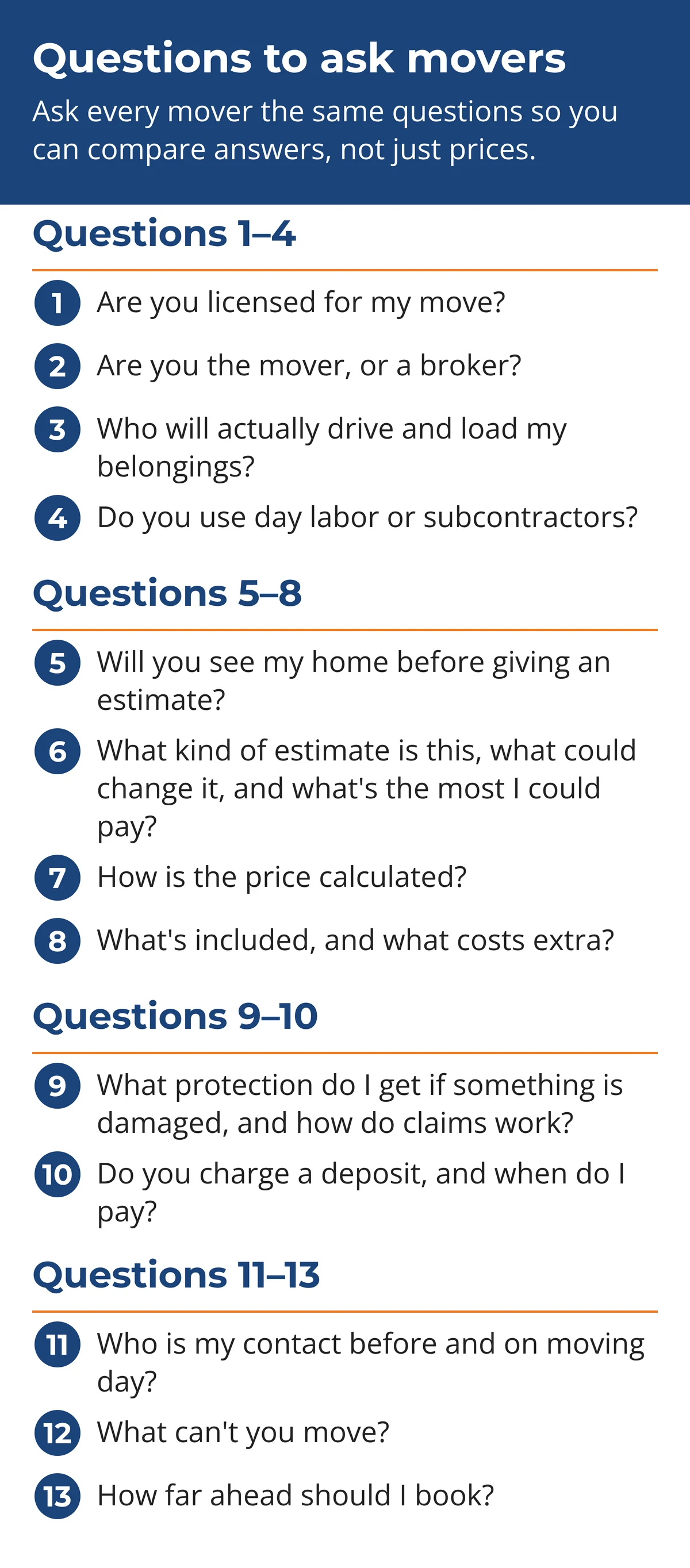
Text version
Questions to ask movers
Ask every mover the same questions so you can compare answers, not just prices.
- Are you licensed for my move?
- Are you the mover, or a broker?
- Who will actually drive and load my belongings?
- Do you use day labor or subcontractors?
- Will you see my home before giving an estimate?
- What kind of estimate is this, what could change it, and what's the most I could pay?
- How is the price calculated?
- What's included, and what costs extra?
- What protection do I get if something is damaged, and how do claims work?
- Do you charge a deposit, and when do I pay?
- Who is my contact before and on moving day?
- What can't you move?
- How far ahead should I book?
1. Are you licensed for my move?
A good answer: a permit or USDOT number you can look up yourself, not just "we're licensed."
For a move inside Colorado, the Colorado Public Utilities Commission (PUC) regulates household goods movers. A PUC permit is the permit the state gives a mover to operate inside Colorado. The PUC says a mover's permit number starts with HHG and should appear on its ads and contracts, and the PUC offers a permit search so you can check any company you're considering. Bailey's Moving & Storage holds Colorado PUC Household Goods Mover permit HHG-00739.
For a move to another state, the company must be registered with the federal government and have a USDOT number, a registration number you can look up in the Federal Motor Carrier Safety Administration's (FMCSA) free registered-mover search. The search shows registration status and safety information. Bailey's Moving & Storage is USDOT 4205683, and Allied Van Lines is USDOT 76235.
Moving inside Utah? This guide covers Colorado's rules and the federal rules for moves between states. It doesn't describe Utah's rules for moves that stay inside Utah, so for a move like that, ask each company to put its answers in writing, read the contract closely, and ask what type of estimate you're getting. If your move crosses a state line, including a move to or from Utah, the USDOT lookup applies.
2. Are you the mover, or a broker?
A good answer: a straight yes or no.
A broker arranges your move for a fee and hands it to another company to carry out, so you may not know who shows up until moving day. A carrier does the move under its own authority. FMCSA's registered-mover search lists the type of business (carrier, broker or freight forwarder), so you can check the answer yourself. Bailey's Moving & Storage is a carrier. We move customers under our own authority and as an Allied Van Lines agent, which has been true since 1954, and you can look up our USDOT number to see how we're listed.
3. Who will actually drive and load my belongings?
A good answer: a plain explanation of who shows up, and a company-owned or marked truck.
FMCSA lists a rental truck arriving instead of a company-owned or marked truck as a warning sign. On local moves, our own company trucks and our own moving crews do the work. Our crews are drug-tested and background-checked.
On a long-distance move, you book with Bailey's Moving & Storage. We're an agent of Allied Van Lines, the van line behind the move, which is the national moving company that runs an interstate move. Most of the drivers who haul long-distance shipments are independent: they run their own trucking businesses and haul for the van line, and they usually aren't our employees. Ask any company how its long-distance drivers work, and who you call when you need to know where your shipment is.
4. Do you use day labor or subcontractors?
A good answer: a direct answer, and a name for any outside company that will touch your belongings.
Day labor means workers hired for a single day, often through a staffing company, who aren't part of the mover's regular crew. Subcontractors are outside companies the mover hires to do part of the job. Neither is automatically a problem, but you should know before moving day who will be in your home. At Bailey's Moving & Storage, we only use approved movers who have completed background checks and meet our standards. A few specialty jobs go to an outside specialist we arrange, such as a safe over about 800 pounds or custom crating, and we'll tell you when your move includes one.
5. Will you see my home before giving an estimate?
A good answer: an in-home or virtual walkthrough. A walkthrough means someone looks at your belongings, in person or by video, before the estimate is written. Federal rules call this a physical survey.
A quote given without anyone seeing your home is one of the most common red flags. For interstate moves, federal rules require the mover to survey your belongings and give you a written estimate based on that survey, unless you waive the survey in writing. The PUC makes the same point for Colorado: a mover who actually looks at your belongings can give a better estimate. We prefer an in-home walkthrough because it shows access, tight corners and truck parking, and a virtual walkthrough is available too. See our U-Haul vs. movers guide for the other red flags to watch for.
6. What kind of estimate is this, what could change it, and what's the most I could pay?
A good answer: a written estimate that names its type, lists what would change the total, and tells you the most you could be asked to pay.

Inside Colorado. The PUC requires a written estimate from every permitted mover, and a signed and dated contract before work starts. Colorado's rules also say a mover cannot charge more than 110 percent of the estimate, so 110 percent of your written estimate is the most you could be asked to pay. On our hourly local moves, we collect up to that 110 percent up front, in case the move runs longer than estimated. The extra 10 percent is only charged if the time is actually used; otherwise it's refunded. For example, on an estimated $2,000 move, up to about $2,200 may be collected, and if the move comes in at the estimate, the extra amount comes back to you.
Between states. The estimate must say whether it is binding or non-binding. A binding estimate is a written price for the quantities and services listed on the estimate. At Bailey's Moving, the binding price reflects the contracted inventory: if the inventory doesn't change, the price doesn't. A non-binding estimate is the mover's best estimate of the total, with the final charge based on what actually happens, such as actual weight. Federal rules say you can't be required to pay more than 110 percent of a non-binding estimate at delivery, plus charges for any services you add after the paperwork is issued. Our guide to binding vs. non-binding estimates explains the difference.
Either way, ask the mover to write down the type of estimate and the most you could pay, and compare that number, not just the estimate. For a move that stays inside Utah, see the note under question 1. At Bailey's Moving, local and in-state moves get a non-binding estimate based on the actual time the move takes; interstate moves get a binding estimate based on the services and inventory listed.
7. How is the price calculated?
A good answer: a clear method you can check.
At Bailey's Moving & Storage, local moves are billed hourly. The clock covers the crew's travel from our warehouse to your home and back, as well as loading and unloading, and local moves typically carry a four-hour minimum. Moves over 50 miles are priced by weight. Ask every company the same thing, and compare estimated hours and crew size, not just the hourly rate.
As Corey Oliver, Relocation Consultant at Bailey's Moving, puts it: "A customer might receive a quote that's much lower than everyone else's, but the company may have estimated far fewer hours than the move realistically requires." For local price ranges, see what a local move in Denver costs.
8. What's included, and what costs extra?
A good answer: an itemized list, line by line.
On our local moves, the truck, dollies, pads and wrap are included, and boxes and additional packing materials are extra. Local moves include a fuel surcharge that changes with current fuel prices; your written estimate shows the amount. The two charges that surprise our customers most are the fuel surcharge and the fact that travel time is billed as part of the hourly rate. Ask any mover about stairs, long carries, shuttle trucks (a smaller truck used when a semi can't reach your home), specialty items like pianos and safes, packing and storage, and how each one is charged. Colorado's rules require a permitted mover's contract to itemize costs and services, including extras.
9. What protection do I get if something is damaged, and how do claims work?
A good answer: the protection level in plain dollars, its cost, and how it connects to a claim.
Valuation is your choice. Valuation is the level of protection you choose for your belongings, and it decides how much the moving company will owe you if something is lost or damaged. It isn't a Bailey's Moving policy; every moving company offers it, much like declaring a value when you ship a package with FedEx. With a mover, you make that choice in your estimate, before moving day.
The two common levels. Released value is the basic level. It costs nothing extra and pays a small amount by weight: $0.60 per pound per article. (Colorado's rule adds "or the article's value less depreciation, whichever is less.") For example, a 40-pound TV that is damaged is worth about $24 under released value (40 pounds × $0.60), however much you paid for it. Full Value Protection is the level most people mean when they want real coverage. The mover is responsible for the replacement value of what's lost or damaged, up to the value you declare. For a move between states, federal rules make Full Value Protection the starting point, and released value applies only if you waive full value in writing. Before you sign, ask which one is on your paperwork. For a move inside Colorado, the PUC requires every permitted mover to offer at least two options, each with its own space for you to accept or reject, and the state's rule calls the full-coverage option "full replacement cost," so you may see that name on Colorado paperwork. We call what we sell Full Value Protection. Colorado's rule doesn't name a default, so ask which option is checked on your paperwork before you sign.
How the options compare, using the same 40-pound TV.
| Option you choose | What it costs | Most you could recover for the TV |
|---|---|---|
| Released value | Nothing extra | About $24 (40 lb × $0.60), whatever the TV cost |
| Full Value Protection, zero deductible | Priced separately; quoted with your estimate | Replacement value, up to the value you declared |
| Full Value Protection, $250 deductible | Generally less than zero deductible | Replacement value up to the value you declared, less $250 |
| Full Value Protection, $500 deductible | Generally less again | Replacement value up to the value you declared, less $500 |
Example only, not a promise: if that TV costs $800 to replace, it's covered within your declared value, and you chose the $250 deductible, you'd get up to $550 ($800 − $250). Under released value, the same TV is about $24. On most of our local moves, Full Value Protection adds about $250–$450 in total (see below).
Deductibles. A deductible is the amount you pay first before the coverage pays. Full Value Protection comes in zero-deductible, $250-deductible and $500-deductible levels, and a higher deductible generally lowers what the coverage costs. Full Value Protection is priced separately from your move and isn't free; your estimator quotes it with your estimate. With us, it adds about $250–$450 on most local moves, and a few larger moves run up to about $850. Those are typical amounts from our estimates, not a quote for your move.
What you recover in a claim follows what you chose and paid for. A claim is the request you make to the mover to pay for loss or damage. If you chose released value and something breaks, the claim is paid by weight, not by what it costs to replace. If you chose Full Value Protection, the claim is based on replacement value up to the value you declared, less your deductible. How to file a claim and how long it takes depend on the company, so ask each mover to explain its process before you hire it. At Bailey's Moving & Storage, your move coordinator is your first call, and our claims page has the claim form and the filing deadlines. For long-distance moves (in-state long-distance, interstate and international), you have nine months from delivery to send in your claim form. For local moves and storage, you have 90 days to notify us of a claim and four months from delivery to send the form. Ask your coordinator which deadline applies to your move. On delivery day, review your itemized inventory and tell your coordinator about anything that doesn't match; our claims page notes that items not listed on the itemized inventory are hard to claim later. Ask each mover how long claims usually take to settle, and check your contract, because other movers may set different deadlines.
Also, be wary of a mover who claims all your goods are covered by its insurance. FMCSA lists that as a red flag.
10. Do you charge a deposit, and when do I pay?
A good answer: a clear, modest policy in writing.
FMCSA lists a mover demanding cash or a large deposit before the move as a red flag. Bailey's Moving normally doesn't require a deposit, and when we do ask for one, it's typically small. On long-distance moves, payment is typically due at your new home before your things are unloaded. If you pay by cash or cashier's check, you pay then; if you pay by card, it's charged on the first day of service. Your estimate and contract spell out exactly how much is due at delivery and how to pay. Card payments may carry a processing fee. Colorado requires permitted movers to accept at least two of four forms of payment (cash, certified funds, a valid personal check, or a valid credit card). On local moves, payment is due on the day of service, by cash, credit card or certified check.
11. Who is my contact before and on moving day?
A good answer: a named coordinator with a direct line, and a number you can call on moving day.
After you book with us, your move coordinator usually reaches out soon after booking; our moving preparation checklist explains what that first call covers. Your coordinator's direct line is on your contract, and the main line is 888-260-5717. Also ask what the company does when a crew or a delivery runs late, and who calls you; our guide to what to do if your moving company is late explains what to expect.
12. What can't you move?
A good answer: a written list.
Hazardous materials, many household chemicals, pressurized tanks and perishable food usually can't go on the truck. For moves between states, federal rules require your mover to give you FMCSA's Your Rights and Responsibilities When You Move booklet, which covers what you should and shouldn't pack, and FMCSA lists a mover who doesn't hand it over as a red flag. Our list of everything your movers won't move has the details.
13. How far ahead should I book?
A good answer: an honest lead time for your date.
Book at least 10–14 days ahead; about 30 days is ideal.
When to walk away
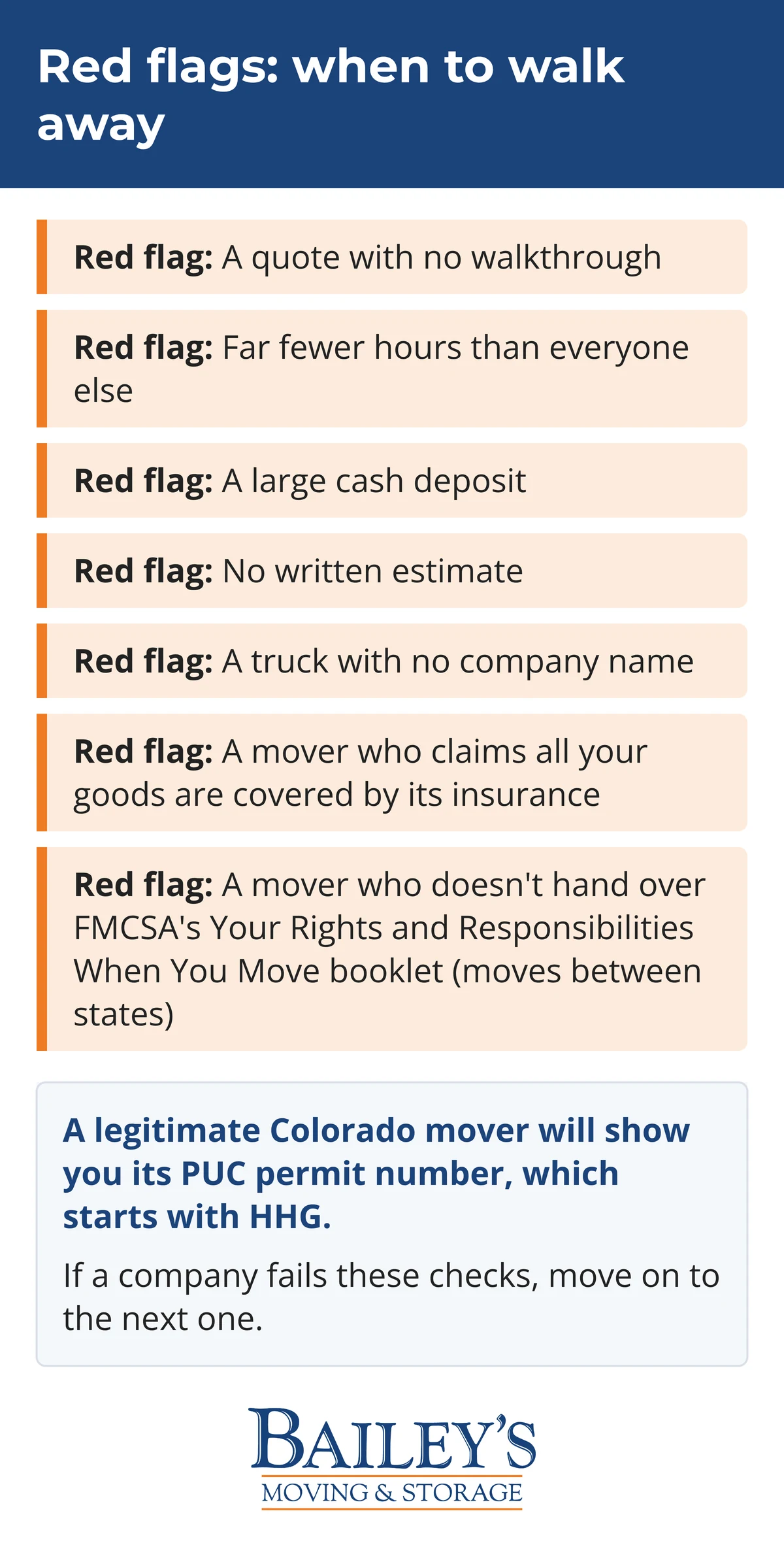
Text version
Red flags: when to walk away
- A quote with no walkthrough
- Far fewer hours than everyone else
- A large cash deposit
- No written estimate
- A truck with no company name
- A mover who claims all your goods are covered by its insurance
- A mover who doesn't hand over FMCSA's Your Rights and Responsibilities When You Move booklet (moves between states)
A legitimate Colorado mover will show you its PUC permit number, which starts with HHG. If a company fails these checks, move on to the next one.
Experience counts too. A company that has trained and checked its crews for a long time has had more chances to get it right, so ask how long a mover has been in business and read reviews that mention damage and how it was handled. Bailey's Moving & Storage has been moving households since 1952.
Walk away from a quote with no walkthrough, far fewer hours than everyone else, a large cash deposit, no written estimate, or a truck with no company name. A legitimate Colorado mover will show you its PUC permit number, which starts with HHG. Our guide to U-Haul vs. movers lists the red flags with examples. If a company fails these checks, move on to the next one.
FAQ
What questions should I ask a moving company?
Start with the 13 above: licensing, carrier vs. broker, who drives and loads, day labor and subcontractors, the walkthrough, estimate type and your maximum price, pricing method, inclusions, protection and claims, deposit, contact, restricted items and lead time.
How do I choose a moving company in Colorado or Utah?
Get written estimates from more than one mover after a walkthrough, check each company's PUC permit (for a move inside Colorado) or USDOT number (for a move between states), and compare answers to the same questions.
How can I tell if a moving company is legitimate?
Look up its PUC permit number for a move inside Colorado, or its USDOT number in FMCSA's registered-mover search for a move between states, and confirm the type of business (carrier or broker).
What is valuation, and how does it affect a claim?
Valuation is the level of protection you choose for your belongings in your estimate, and it decides how much the mover owes you if something is lost or damaged. What you can recover in a claim follows the level you chose and paid for, so decide it before moving day.
What's the difference between released value and Full Value Protection?
Released value is the basic level and pays a small amount by weight; in Colorado, that is the lesser of $0.60 per pound per article or the article's value less depreciation. Full Value Protection makes the mover responsible for the replacement value of what's lost or damaged, up to the value you declare, with zero-deductible, $250-deductible and $500-deductible levels.
How far ahead should I book movers?
Book at least 10–14 days ahead; about 30 days is ideal.
This guide isn't legal advice.


